
A pandemic reminiscence
It's never too soon to prepare
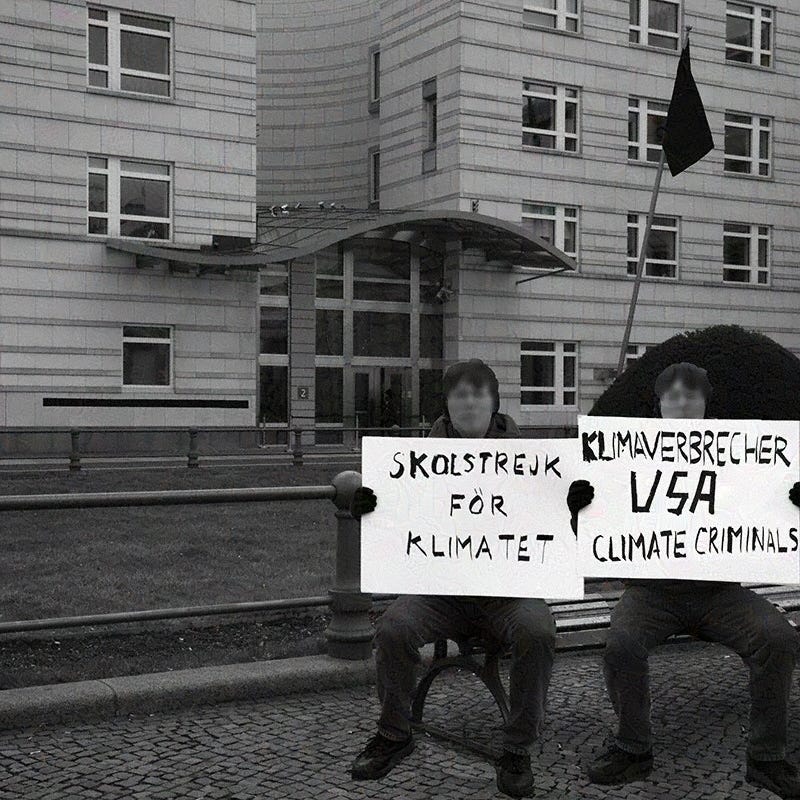
It was an eventful day, one that saved my life and the lives of those about me. No, I'm not writing about the climate strike my clone and I did at Pariser Platz, but rather the Anne Will show on ARD that evening, with an expert guest answering questions about the looming pandemic. [1] The discussion was sober and enlightening, so much so that when I returned to the US less than a week later I had the distinct feeling of having landed on another planet and knew that I needed to be very proactive.
At the onset of the COVID-19 pandemic, it was widely expected that the US would lead the world in its response, and that the world could confidently count on the US for sound guidance. It was clear by the end of February that the world would be disappointed. The degree to which a health care system will respond correctly to a health crisis is inversely correlated to the degree of its control by narcissists. This is not simply an indictment of the US' leadership: Over the course of the pandemic, the highest fatality numbers befell countries run by actual or would be autocrats: USA (Trump); Brazil (Bolsonaro); Hungary (Orban). It is generally suspected that Russia (Putin), the PRC (Xi) and Turkiye (Erdogan) would be included in this list if their governments published factual health statistics. In the case of Russia, at least, it is possible to verify the lies, because they stupidly continued to report overall deaths, which made it possible to calculate the excess deaths, which are attributable within statistical limits to the pandemic.
As it became obvious by March of 2020 that the US government was unwilling or incapable of communicating factually about the pandemic, I started looking for outside sources of information. Fortunately, my German is good enough to make accessing the RKI [2] useful. I also discovered the equivalent of the arXiv website for medical preprints [3]. From that I quickly learned that the primary mode of coronavirus transmission is airborne, which was a huge factor in designing our family's strategy for avoiding infection.
The situation vis-a-vis airborne transmission tells volumes about the political situation in the US, the real expertise of the US higher medical establishment, the lack of material preparedness and the dominant concept of negative freedom. There was ample evidence very early on that the primary mode of disease transmission was airborne, and by April 2020 its scientific basis was sufficiently established to permit the RKI to say so [4]. Still, the topic was considered controversial in the US, leading to publication of a plea signed by over 200 scientists for recognition of the obvious fact [5]. Because of massive outsourcing to China, personal protective equipment (PPE), including not only masks but also protective apparel for hospital workers was in extremely short supply, with its obvious effect on the willingness of Government officials to even recommend mask wearing. Not that it provided an excuse - I vividly remember a TV news item featuring a businessman in Texas, standing in his empty mask fabrication facility, lamenting his having been driven out of business because US pharmacy chains chose Chinese masks costing tenths of a cent per piece less than his break-even price, and that he would happily rehire his workers and go into production were the Government to offer a guaranteed order. As far as I can tell, the company received no such guarantees, and if my own experience is typical, we are still reliant on imported PPE. Readiness for a pandemic is an individual responsibility in the US. If you want to protect yourself from airborne pathogens, make sure to have an adequate stock of PPE.
From the beginning there was resistance to the simple but highly effective measure of mask wearing to slow the progression of the pandemic in the US. This resistance was founded on the negative freedom concept that proposes any restriction as a violation of personal freedom. According to that concept, personal freedom is restrained by laws that dictate which side of the road we drive on, for example. The comparison is direct: By not wearing a mask, like driving on the left (in the US or EU) one endangers not only ones self but others, while driving on the correct side of the road or wearing a mask promotes safety. It is revealing of the fundamental inconsistency of how Americans view freedom that not wearing a mask can be viewed as a patriotic act when in fact it is the opposite. Alas, Timothy Snyder had not written his wonderful book [6] at the time of the pandemic.
During the first half year of the pandemic, much effort was devoted to estimating its ultimate impact and studying the potential impacts of various interventions using mathematical modeling tools. I write here of tools applied at a macroscopic as opposed to cellular level. Two general families of approaches exist: aggregate models (my terminology) and network models. In the former, the population is assumed to be uniform in all respects, and the evolution of the pandemic is described in terms of a set of coupled linear differential equations. The starting point is the SIR model, in which the population is comprised of Susceptible, Infected, and Recovered components. In case of severe diseases such as COVID-19, the R component is further subdivided into Recovered and Dead fractions. The equations are linked via a set of disease-specific parameters, the most publicized of which is Ro, the basic replication rate. The value of Ro determines the rate of disease progression: less than 1, and it dies out; equal to 1, stable; greater than 1, increasing number of infections. The parameter is extremely difficult to measure, leading to wild variations in the predictions of pandemic severity. These models predict that not everyone will be infected, leading to the concept of herd immunity, which is achieved when a sufficiently large fraction of the population has recovered or died off. For a while, there was a great deal of public discussion about herd immunity.
That discussion died off as it became apparent that contracting the disease and recovering does not confer immunity, and that the disease was evolving, with multiple variants existing simultaneously. The SIR approach to modeling became ever more complex, as the equations were modified to cope with new discoveries about the disease. Additionally, some effort was devoted to network type models, in which individuals are nodes, connected to other individuals with lines having weightings dependent on frequency of contact especially. Such models offer the conceptual advantage of allowing distinction between densely- and sparsely populated areas, but are inherently doomed to failure because for a population of even a billion people, there are more possible interconnections than atoms in the observable universe, and moreover the network is not time stationary. In the end I used various versions of the SIR model to help understand the pandemic progression and to assess the possibilities for success of various strategies that were being employed. As R.W. Hamming said, "The purpose of computing is insight, not numbers".
Tracking the evolution of the pandemic and assessing the efficacy of the various measures being taken to address it requires data. At the start I used the same source as most of the US major media, but I quickly discovered faults with their reporting, so switched to a statistical website, which was better for a while. As the pandemic progressed, data anomalies became both more frequent and apparent, and it became necessary to use a variety of sites as sources; some of these were national sites. In the end, pandemic fatigue overtook even the most diligent and reporting devolved from daily to several times a week, to weekly. This, coupled with practices of some countries like Russia of vastly under-reporting, to non-uniformity in attribution (for example, coroners in various US localities deliberately misattributed COVID-19 deaths to other causes) made it challenging to formulate a coherent picture and portents ill for efforts to keep track algorithmically.
It was dismaying to observe how disinformation, originating mostly in the US, spread worldwide and impeded progress in countering the disease, leading to many unnecessary deaths. Germany is a case in point. The entire country did very well initially, observing lockdowns, social distancing and masking regulations, and using testing pretty effectively. But resistance arose in the former East German Länder, leading to protests and disregard of even the most benign measures. As a result, they suffered the highest death rates in the country. In the aftermath, the Nazis of the NPD and its successor the AfD falsely accused the Federal government of withholding vaccines. Oh, and BTW guess where the greatest anti-vax sentiment in Germany was (and is)! In 2021 Illary et al. published results of an analysis showing that despite attempts by moderators to highlight truthful posts, Facebook streams became rapidly dominated by disinformation. [7]
By the fall of 2020 Professor Martin Bazant offered his course on the physics of COVID-19 transmission [8]. It was there that I was formally introduced to the Guangzhou restaurant event (January 2020), the Diamond Princess (February 2020), and the Skagit County WA choir (March 2020) mass outbreak events, which all pointed to airborne transmission. I also learned the importance of good ventilation, consisting of effective filtering, robust recirculation and introduction of outside air in enclosed spaces, and how to calculate exposure risk. It caused me to pay attention to the replacement interval for our MERV-13 home air filters [9], and to recall a lecture from an American Physical Society meeting a few years earlier by Amory Lovins, whose institute has revolutionized air handling system design efficiency. Lovins has demonstrated (for instance at the Empire State Building) that it is possible to achieve better air quality and lower operating costs with more efficient duct design and layout.
As I tracked the progress of the pandemic, I noticed how it was affected by the attitude of the political leadership, the cohesiveness of the society, and the scientific aptitude of the population. [10] It was also noticeable that as the pandemic progressed, the patience of the public waned even in the best led, most cohesive and scientifically literate societies. There is a limit to what humans will tolerate, especially when dealing with an invisible threat.
As the pandemic continued to ravage the US, I started wondering why the public health response was for the most part pathetic. The answer to part of the question came from Michael Lewis' The Premonition [11] during the spring of 2021. There I discovered how the US has a patchwork of public health agencies, and that the CDC is frequently regarded as their enemy. In an effort to deepen my understanding, I scoured the CDC web site, looking for material on COVID-19 and airborne infections in general. It was amazing to discover that the CDC did not have any internal organization devoted to airborne diseases. This despite the 1918-20 pandemic and all the annual (Corona virus) influenza outbreaks. For the CDC, it's largely about John Snow and the Broad Street pump [12]
Ironically, although the US administration helped accelerate the development of COVID-19 vaccines, its most loyal supporters were - and remain - the most hesitant to get vaccinated, if not altogether against vaccination. In countries and regions where vaccine uptake was most rapid and comprehensive, for example Israel, Scandinavia and the west of Germany, the fatality rates declined rapidly.
In summary the advice based on lessons I learned from the COVID-19 pandemic is:
Before listening to any public figure, consider their credibility on scientific topics, their willingness to listen to advisors from the scientific and medical communities, and whether their message is one of positive freedom;
Seek out high quality information, if possible from the medical and technical communities. Do not pay attention to anything posted on social media. Fact check. Evaluate the advice of your local public health authorities and heed it if it appears to be based on well founded scientific reasoning;
But be prepared for the public health consensus to change as more becomes known about the disease;
Isolate yourself and your family as much as possible until the pandemic ends or an effective vaccine (or treatment) becomes widely available. Maintain a stockpile of the appropriate PPE such as N95 masks for use whenever it is necessary to venture out;
Avail yourself and your family of vaccines as soon as they become available, and keep up to date with boosters as appropriate. Along those lines, given the attitudes expected to be prevalent in the next four years, ensure that ALL your immunizations are up to date prior to January 21, 2025.
There are a number of areas suggested for study and follow up action. They include
Modeling suggests that implementation of robust ventilation systems in enclosed public spaces could mitigate against airborne spread, especially if used in conjunction with mask wearing and proper testing. If true, it opens the possibility of limiting costly and unpopular lockdowns, protecting essential workers and allowing schools to remain open. To be effective, studies of this hypothesis would need to be followed up with government mandates for appropriate ventilation, and for changes to building codes to require both efficient air handling system design and the ability to incorporate appropriate filtration plus introduction of outside air, with multiple change per hour capacity, when the pandemic strikes[13].
The various national strategies need to be compared in terms of their effectiveness in reducing the incidence of COVID-19 cases, hospitalizations, and deaths. For instance, those statistics for Denmark, Norway, Sweden and Finland suggest that the Swedish decision to not impose restrictions during the pandemic was initially disastrous, though the other Nordic countries performed somewhat worse than Sweden during the later stages, after pandemic fatigue set in and lockdowns were partially lifted. What would a thorough analysis reveal?
The pandemic response was plagued with inequities, with resources - especially vaccines - disproportionately distributed to rich nations. One response was a project initiated by BioNTech to build and deploy modular vaccine factories to emerging nations, the factories designed to remain idle but ready to be quickly activated when a pandemic hits. BioNTech and the host nations lacked the monetary resources to widely deploy these factories. A study should be performed to determine the potential effectiveness of such a scheme, and rich nations should contribute to its implementation if the study indicates sufficient promise.
It seems pretty clear at this juncture that the story of the 2019-2022 pandemic will be rewritten to minimize the effects of malfeasance, and that we are setting ourselves up yet again [14] to validate Hegel's cynical assertion that the only thing we learn from history is that we learn nothing from history. Unless we decide to remember what really happened, learn from it and pass it on.
I close this post by paying tribute to the people who most helped me understand how to survive, and who materially contributed to our survival. In alphabetical order: Professor Martin Bazant of MIT, Dr. Christian Drosten of Charité, Dr. Anthony Fauci of NIH, Dr. Karl Lauterbach of RKI, and Drs. Ugur Sahin and Özelm Türeci of BioNTech.
Postscript:
Although with the knowledge gained with the help of the people mentioned and BioNTech's vaccines most of our family made it through unscathed, we lost a member to COVID-19. The mother of my Lebensgefährtin was a patient at a rehabilitation facility when the pandemic struck. They tried to do everything right: locking the facility down, no visitors from the outside, frequent PCR tests for the staff. After some months of this, they admitted an ostensibly clean new patient, who had tested negative shortly prior to transferring in. But they developed symptoms, and the disease spread rapidly via the ventilation system. Frances Tyksinski: Say her name.
Notes
[1] I honestly don't recall whether it was Karl Lauterbach, who at the time was head of the Robert Koch Institut (RKI) or Christian Drosten, head of virology at Charité.
[2] https://www.rki.de/EN/Home/homepage_node.html As you see, some of it is even available in English. During the pandemic, a special page was set up for COVID-19.
[3] https://www.medrxiv.org/ had a special category for papers dealing with the pandemic. Early on it was possible to do a good scan of the new postings on a daily basis, but with time the volume became overwhelming. In using this as a source, it is important to keep in mind that the papers appearing here are only weakly filtered, so the possibility of an entry being junk science must always be considered. One way of filtering is to look for independent papers supporting the same conclusion. Another is to eschew papers based on small samples.
[4] https://www.rki.de/DE/Content/Infekt/EpidBull/Archiv/2020/Ausgaben/17_20.html
[5] https://pubmed.ncbi.nlm.nih.gov/32628269/
[6] Timothy Snyder, On Freedom
[7] https://arxiv.org/pdf/2110.09634.pdf later published in Science as https://www.science.org/doi/epdf/10.1126/sciadv.abo8017
[9] MERV 13 filters remove 50% of 0.3 - 1 micron sized particles per pass; MERV 10 and lower remove none, while MERV 14 and above remove more. Virus and pollen particles are in that size range. If your air filter is rated below MERV 13, it does little or nothing to protect you from viruses and pollen.
[10] It needs to be borne in mind that in many cultures and subcultures, there is an almost innate distrust of western medicine resulting from past abuses. For instances, many Afro-Americans recall the Tuskegee Experiment, and many Pakistanis recall the CIA operation that purported to be vaccinating children while actually extracting DNA samples in their search for Bin Laden. Otherwise, anti-vaxism must result from some combination of stupidity, ignorance and high dark triad scores.
[11] Michael Lewis, The Premonition
[12] https://archive.cdc.gov/www_cdc_gov/csels/dsepd/ss1978/lesson1/section2.html Also, recall that in the early days of the pandemic the RKI offered us their effective PCR test, but the CDC refused, prefering a test of their own design. The CDC test did not work, leading to additional months during which the US had no means of testing. In fairness to them, the decision to refuse the Germans' offer was probably taken at the highest level. Make American Graves, Again.
[13] This is a win-win proposition. Better, more efficient air handling systems using MERV-13 filters cut energy use, paying for theselves while lowering greenhouse gas emissions, and helping stem the spread of seasonal flu.
[14] "yet again" because at the time of this pandemic, the one of 1918 - 20 was almost entirely forgotten. Surely you have heard of World War I, with its estimated 15-22 million deaths, worldwide. Why don't we see similar historical coverage of the so-called Spanish Flu, for which the accepted range of estimated deaths was 25 - 50 million: millions, perhaps tens of millions more than WWI?
https://en.wikipedia.org/wiki/Spanish_flu and https://en.wikipedia.org/wiki/World_War_I_casualties
PBS Frontline: The Virus: What went wrong?
Well said and documented. How soon we forget. Even though so many lost, and continue to lose, family members dear to them the refusal to get no cost vaccines and wear masks when necessary is viewed by same as a restriction of their freedoms. On the other hand anti-bacterial soaps are the most popular soaps/detergents on the market.