
BECCS may not be BE + CCS
Greenwashing the terminology
Insight into the reason why the IEA would make the claim that BECCS is green can be gleaned by reading the list of individuals who contributed to or reviewed the report, with careful attention paid to the identities of their employers.
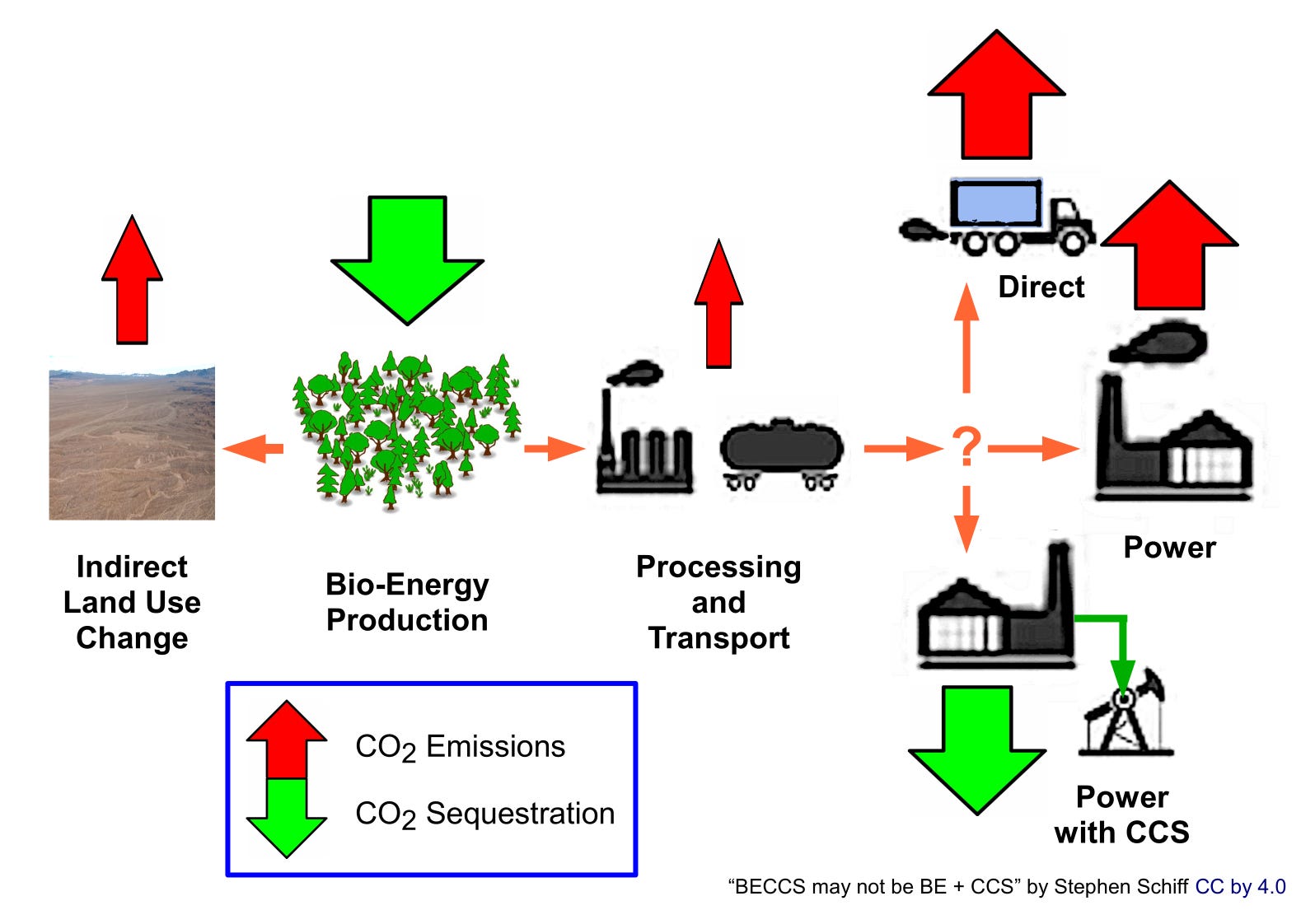
Naivety dies hard, I'm afraid, and mine suffered yet another blow recently when I read an article that made what appeared to be impossible claims concerning the cost of Carbon Capture and Sequestration (CCS) [1]. The article, which I will not reference to avoid participating in the propagation of disinformation, was uncritically based on an International Energy Agency report that made the false claim that all uses of biofuels are a form of CCS. BECCS literally means "BioEnergy Carbon Capture Storage", which would rationally be interpreted as BE with CCS or BE and CCS, but that is not the case per the IEA. Their meaning includes BE = CCS [2]. In this post, I seek to set the record straight.
Bioenergy is that contained in biofuels, and biofuel is a term used to distinguish between fuels derived from plant material that was recently alive, from fossil fuels, which are derived from plant material that has long been dead. As we all know, plants remove CO2 from the atmosphere and utilize it to form living matter. This material can then be used to provide energy either directly, as in the case of fire wood or indirectly, as for example by producing ethanol from sugar cane. (As it turns out, corn is just among the worst possible choices as a feedstock to produce ethanol.[3]) The key point is that when the biofuel is used, essentially all of the CO2 it removed from the atmosphere is returned to it. The accounting of the green washers would have it that the process is 100% efficient, meaning that the growing of biofuels and their subsequent use is carbon-neutral, but in doing so they ignore the energy costs and CO2 emissions resulting from the transportation and processing of the biofuel material, and the indirect cost through the loss due to land use changes. An example of the latter is when a natural, old-growth forest is cut down and replaced by a tree farm which is harvested every 20 - 40 years to make biofuel. This produces a net increase in the atmospheric CO2 balance because trees sequester more CO2 per year as they age, so replacing a forest with a 50/50 mixture of medium growth rate hardwood and coniferous trees averaging 50 years old with one consisting of 100% medium growth rate conifers with an average age of 20 years reduces the CO2 sequestration rate by about one tonne per hectare per year. On an average per-tree basis, the mixed species 50 year old forest sequesters about 3.4 times as much CO2 per year as does the 20 year old conifer tree farm. It makes zero sense to cut down old-growth forests.
Along those lines, some recent news: The EPA is being sued for failing to follow its own rules in approving corn for biofuels expansion in the US. A poor choice of a crop for biofuels, industrial agriculture, destruction of biodiversity: what's not to like[4]?
According to the IEA report, ''By 2050, around half of BECCS capacity is in the power sector and the remainder primarily in producing alternative low-carbon fuels, in particular biofuels." The report goes further to project that by 2070, all coal and gas-fired power plants will be equipped with CCS, but only half the biofueled ones will. If true, biofuels will be the primary source of greenhouse gas emissions in the power industry by 2070.
Referring to the figure at the top of the article, we see that three usage paths exist for biofuels. Per the foregoing, in 2070, about half the biofuel usage will be in the transportation sector, and of the remainder, about half will be used to generate electricity with CCS. The net negative emissions associated with electricity generation from biofuels with CCS will be offset by the positive emissions associated with electricity generation from biofuels without it. That leaves the net emissions of the transportation sector uncompensated. Getting to zero emissions means going to zero emission vehicles, and not ones that involve a cycle that puts more CO2 into the atmosphere than is removed. A true zero emissions scenario would involve land use policies that did not result in increased CO2 emissions, together with CCS associated with the processing and transportation of biofuels, and fitting of all biofueled power plants with CCS. In other words, coupling every upward pointing red arrow in the figure with a downward pointing green one. Were it the case that every emission associated with bioenergy was associated with an equal CCS element, BECCS would be a carbon negative technology, capable of playing a role in the restoration of the atmosphere.
At the heart of the lack of understanding of the need for carbon sequestration is the focus on achieving net-zero, while what is needed is a roll-back of atmospheric CO2 concentrations to 1988 levels (350 parts per million). Plans to gradually decrease CO2 net emissions to zero are in reality plans to continue increasing the CO2 concentration in the atmosphere, which will in turn lead to more negative effects of climate change. Whether the goal be to restore the atmosphere to 350 ppm or to the current value of around 423 ppm, every gram of CO2 put into the atmosphere from now on will have to be removed. Green washers can posture all they want about bioenergy or natural gas being green, but mother nature is not fooled. We shouldn't be either.
Notes
[1] Notice that I don't use "Storage" as the S-word here because it implies a short term phenomenon. We need to sequester captured CO2 for at least thousands of years.
[2] Insight into the reason why the IEA would make the claim that BECCS is green can be gleaned by reading the list of individuals who contributed to or reviewed the report, with careful attention paid to the identities of their employers.
[3] Ethanol is the poster child for biofuels, although there are many other forms. Not all ethanol is a biofuel, as some comes from petroleum. https://en.wikipedia.org/wiki/Ethanol_fuel
[4] It's off topic, but the same article states that almost 90% of the corn grown in the US is used either to produce ethanol or as cattle feed. Apparently nobody has noticed that there is a critical grain shortage that the Russians are making worse every day. How many deaths from starvation would be avoided if, just for a couple of years, half that acreage was diverted to producing wheat?
[5] linked IEA report, page 50.
(Re-posted 22 Jan 24 without changes)