
Carbon in the atmosphere
And its removal; an update
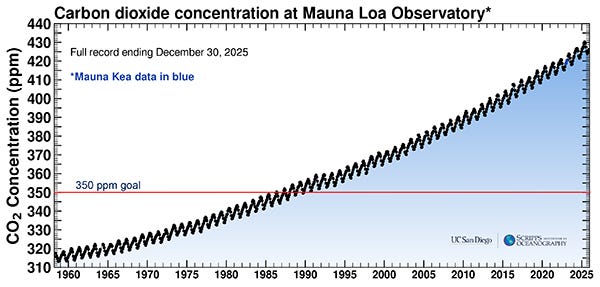
Looking back at the climate in 2025, there is some bad news and some good news. I wrote this post to bring us all up to date on greenhouse gas emissions and related topics, and to divert myself and my readers for a moment, from the awful political events going on around us. It is useful to recall that there is an ongoing, worsening climate crisis that will require even more effort to address when we finally are able to do so. Fortunately, as you will see, some nations have not abandoned the effort.
Ch. 1: Emissions of Greenhouse Gasses
A routine headline with respect to climate change is about carbon dioxide emissions; the curve at the top of the post tells the story as of December 2025. If it appears to you that the curve is bending upward, you would be right: I did fits to the annual average data and found that a second degree polynomial fits the data better than a linear fit [2]. In plain English, the concentration of CO2 in the atmosphere is accelerating: On the average, we add more CO2 to the atmosphere each year than we did the year before. Per [3], the estimated total CO2 emissions for 2025 amounted to 42.2 Billion metric tons, i.e. 4.22E10 tons. Most of the increase was due to the burning of coal and oil.
Carbon dioxide is not the only greenhouse gas, and moreover emissions associated with combustion are not the only factor leading to increased concentrations of greenhouse gasses in the atmosphere. Below is a more complete indication of the true state of affairs.
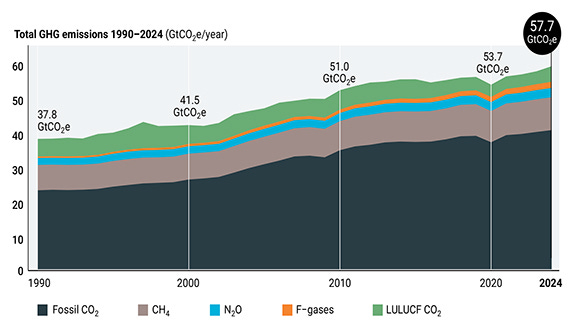
In the figure, F-gases are man-made substances used as insulators and substitutes to ozone-depleting substances such as refrigerants, and LULUCF stands for Land Use, Land Use Change and Forestry.
Per [3], three countries accounted for over 50% of the CO2 emissions in 2025: China, the US, and India, in that order. China appears to have reached its peak coal consumption, and the US increased its emissions after about a decade of modest declines. India appears to be rapidly increasing its emissions. The following G20 member states noted continued progress in working toward eliminating GHG emissions: Australia, Canada, EU, Japan, and UK, although only the EU appears to be on track for Net-zero GHG emissions by 2050. [4] The remaining G20 nations are struggling to make progress.
Ch. 2 Positive news for renewables and GHG tracking
The primary reason why the EU is on course toward eliminating carbon emissions, and the primary reason for China’s reaching peak coal use is the accelerating roll-out of renewable energy in the forms of solar and wind energy. Consider this: in 2020 solar power had just overtaken hydroelectric as the 4th leading source of power, world wide and in 2025 is overtook coal for 1st place [5] Additionally, wind overtook hydropower etc for 4th place. Here’s the chart, with final 2025 values estimated:
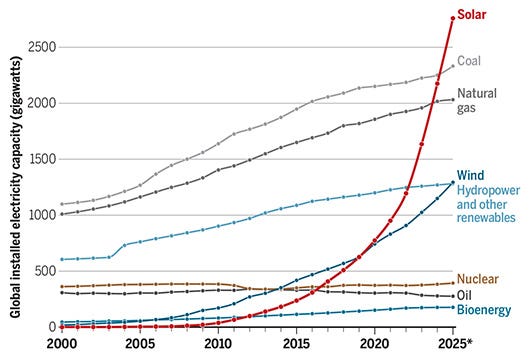
There is a simple reason for the explosive growth of solar power, and for the steady growth of wind power, and it is cost. Both – and especially solar – are experiencing technological advances and are truly mass producible, meaning that their production is able to realize economies of scale. Moreover, storage technologies, mostly batteries, likewise enjoy economies of scale in production and moreover are experiencing fast technological development through research on battery chemistry (e.g., sodium ion batteries).
One of the problems facing pollution regulators in the past has been an inability to trace GHGs, and particularly methane, to their sources. Past estimates of CH4 emissions have largely relied on the good faith of the fossil fuel industry (an oxymoron). No longer. As reported in [6], a group of mostly Canadian researchers have used data collected by the Canadian satellite GHGSat to detect over 8 million tons per year of methane emissions from 3114 emission sites associated with oil, gas and coal extraction. In the long term, data such as these will enable governments and other litigants to regulate and extract penalties from methane polluters.
Ch 3. Status and outlook for Carbon Capture and Sequestration (CCS)
If GHG emissions due to human activity were to cease entirely – a practical impossibility – atmospheric concentrations of greenhouse gases would stabilize after some time, once planetary emission and absorption processes reached equilibrium. What that means is that absent human intervention, the climate would not cool down on its own. The global community established goals for human emissions reductions to reach a target global warming of 1.5C (2.7 degrees Fahrenheit) over pre-industrial levels. At present, we are roughly 1.23C warmer, and would produce no more than 170 Billion tons of CO2 (170 GtCO2) before reaching reach zero emissions – less than 4 years worth at current levels - to meet the 1.5C goal. Clearly that is not going to happen, and various analysis scenarios yield warming by as much as 4.6C by century’s end [4], with a 66% chance of it being in the range 2.1-3.9C, assuming policies in place when [4] was written remain in place.
Of the finite [6] human interventions, CCS seems attractive because it doesn’t require changing our terrible land use habits and doesn’t even require us to stop using fossil fuels. Various implementations are envisioned, chief among which are capture at the source and direct air capture (DAC). In the case of capture at the source, the CO2 capture apparatus is installed so as to receive its input at high CO2 concentrations, for example at the exhaust of a fossil fuel fired power plant. It is much more efficient than DAC because much less input material needs to be processed per ton of CO2 captured. According to [7] the cost per ton of CO2 removed varies from $15 -$25 per ton in the case of highly concentrated gas streams associated with ethanol production or natural gas processing to $40 - $200 per ton for less concentrated streams associated with cement production or power generation. For DAC, the current range is $600 - $1000 per ton, with hopes that it can be brought down to $200 per ton by 2050. Incidentally, the long term goal for DAC in 2023 was $100 per ton.
While removing CO2 from the exhaust streams of industrial processes is a good thing, it only reduces emissions: the net result is the addition of CO2 to the atmosphere. Of the technological CCS approaches only DAC has the promise of reducing atmospheric CO2 concentrations. Think about the cost: In 2025 alone the CO2 emissions were over 40 GtCO2. Assuming the cost goal was reached, removing the CO2 emitted in 2025 alone would cost over $8 Trillion. Given that the amount of CO2 emitted over the period 1990 – 2024 was over 1.1 Trillion tons, the cost of removing all the CO2 emitted over the period 1990 – 2025 would come to over $220 Trillion at best.
The World Economic Forum’s projections for CCS cannot be viewed as encouraging if CCS is envisioned as a solution to the problem of excess CO2 in the atmosphere. They project CCS capabilities for removing 0.5% of a projected 35 GtCO2 emitted in 2030, growing to 6% of 21 GtCO2 emitted in 2050. [8] Of those amounts, most if not all are tied to industrial processes and power plants, meaning that they envision little if any DAC activity. The oil and gas industry investments in CCS are noted without comment; we should recognize them as being in service of CO2 injection in support of fracking operations as opposed to indicating a reversal of the industry’s policy of climate change denial. To put CCS into perspective, it was responsible for removing 0.001 Gt CO2 in 2025. That year, the agriculture sector removed 0.007 GtCO2 and forests removed 2.2 GtCO2 [9].
I promised to constantly remind my readership of the need for everyone who believes in freedom and democracy to behave in accordance with those beliefs, every day. For what that means, see

Notes
[1] https:/keelingcurve.ucsd.edu NB I have drawn a line at 350 ppm representing the consensus goal for CO2 concentration.
[2] A linear fit grossly underestimates the data near the beginning and end of the sample period. The quadratic fit does well over the entire period, as indicated by its R2 = 0.99953. As always, I will provide the analysis to any paid subscriber upon request.
[3] Müller-Hansen, S (2025)., Emissionen aus Kohle, Öl und Gas auf Rekordhoch, Süddeutsche Zeitung, Nr. 262, s. 14
[4] United Nations Environment Programme (2025). Emissions Gap Report 2025: Off target – Continued collective inaction puts global temperature goal at risk [Olhoff, A., chief editor; Lamb, W.; Kuramochi, T.; Rogelj, J.; den Elzen, M.; Christensen, J.; Fransen, T.; Pathak, M.; Tong, D. (eds)]. Nairobi. https://doi.org/10.59117/20.500.11822/48854.
[5] Appenzeller, T. (2025). Good Morning Sunshine: The seemingly unstoppable growth of renewable energy is Science‘s 2025 Breakthrough of the Year. Science, 18 December, pp. 1208-9
[6] “finite” to distinguish between interventions such as CCS, land use, and reforestation, which accomplish the goal of atmospheric GHG concentration reductions within some finite period of time and those such as Stratospheric Aerosol Injection which, if not carried out in conjunction with an effective finite method, must be carried on forever.
[6] Jervis, D., et al. (2025). Global energy sector methane emissions estimated using facility-level satellite observations Science, 11 December, pp 1151-5
[7] Krogman, J. and M. Ganesan (2025) Carbon capture technology is ready to expand into industrial usage. American Chemical Society, 22 December, https://www.cas.org/resources/cas-insights/carbon-capture-technology
[8] Alvik, S. (2025) Carbon capture and storage is at a pivotal moment for decarbonization. Here’s why. World Economic Forum, August 5, https://www.weforum.org/stories/2025/08/carbon-capture-storage-decarbonization-pivotal-moment/
[9] P. Friedlingstein et al. (2025) Global Carbon Budget. Global Carbon Project, 13 November, https://globalcarbon.org/gcb-2025/