
Extreme (climate) Event Attribution July 2026
Its legitimacy inadvertently endorsed by MAGA
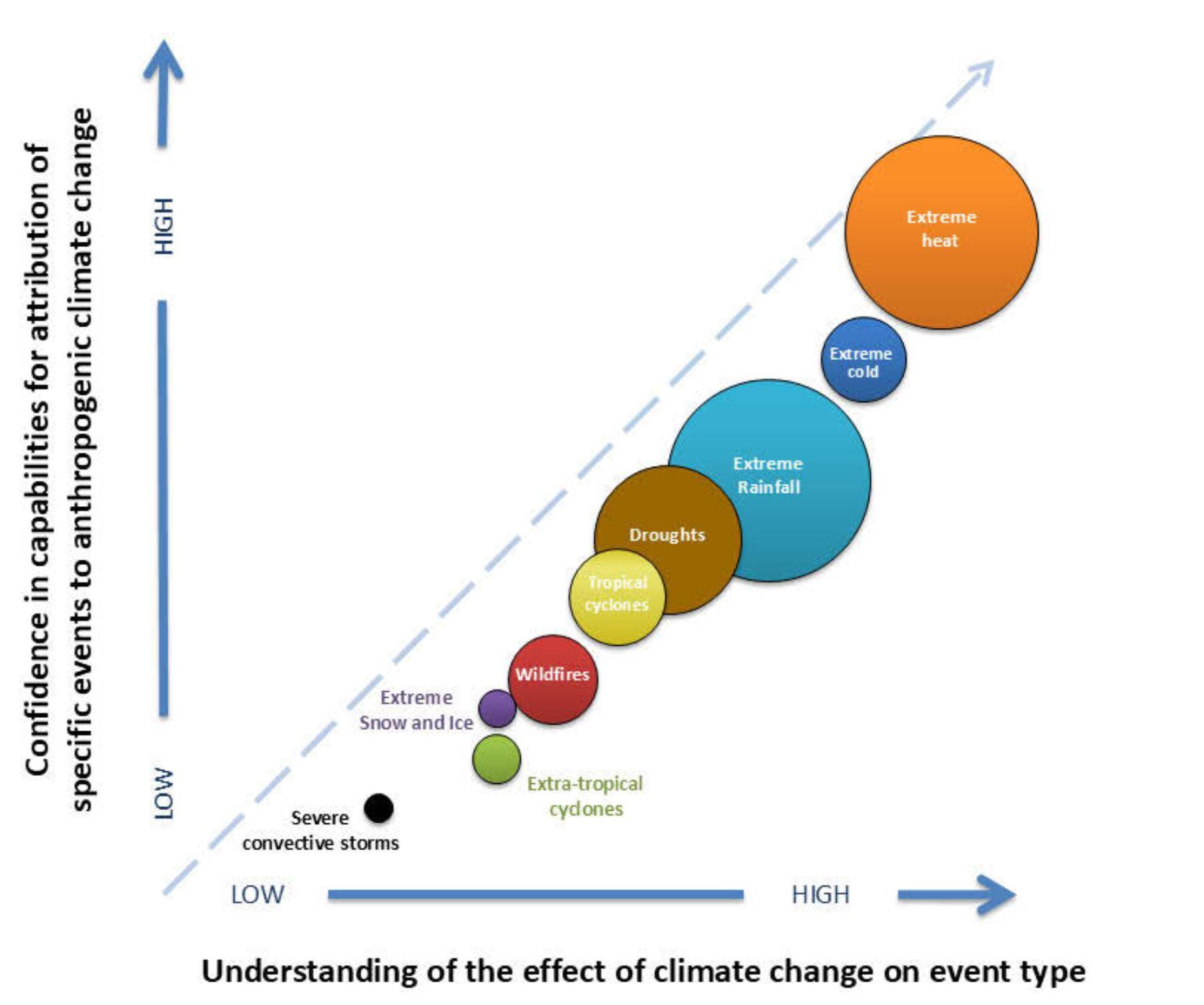
Three recent events motivate me to update an earlier set of posts on the topic of extreme event attribution (EEA) to climate change by scientific means [2] – [4]. The motivations include interference by the Trump administration in judicial processes involving scientific evidence, the recent spate of gigantic wildfires in Canada, Europe and now the western US, and the publication of a new report on EEA by the National Research Council (NRC).
The NRC report, currently published in draft form, contains no real surprises to my readers aside from the apparent refusal of its authors to succumb to pressure from the antiscience forces within the Trump administration and its enablers in Congress and elsewhere. It recognizes the great progress made in the ten years since the previous NSF study [5] was conducted. The figure above, stolen from the current report, summarizes their estimation of the current state of EEA, in terms of the current state of attribution science (abscissa) and the confidence in capabilities for attribution to specific events (ordinate). In the figure, the sizes of the bubbles encode the relative numbers of EEA studies completed to date. That all the bubbles lie below the dashed diagonal line (understanding = confidence in specific event attribution) indicates the study’s assertion that there is “the ability for improvement in the attribution capability in areas such as modeling, observational record, and understanding of the physical mechanisms.” Of course this is true, and will remain so for the foreseeable future if for no other reason than because adequate historical data do not exist for many regions. And we can all agree that science is always a work in progress, with improvements in the understanding of the underlying physical processes as time goes on, and with model improvements largely occurring as a result of improved understanding. The NSF study encourages further work to broaden the ability of EEA science to perform timely evaluation of extreme weather events.
Moving now to the topic of wildfires, the figure indicates a low understanding of them being the results of climate change with correspondingly low confidence in the capabilities for attribution of specific events to climate change. There are a number of problems with trying to tie wildfires to climate change. Looking at the figure, we see two categories of extreme events – droughts and extreme heat – that are generally preconditions for wildfires, are better understood and better correlated to specific events. It therefore follows, mathematically, that wildfires cannot be equally or better understood than the correlated conditions. Moreover it is known that many wildfires are ignited by human activities having nothing whatsoever to do with climate change; carelessness and arson, for examples. Thus when we attempt to ascribe a particular wildfire to climate change, the focus should be on the conditions that encouraged wildfire initiation rather than the wildfire itself. In that context, wildfires are derivative events.
Finally, it appears that the growing capability for attributing various disasters to anthropogenic climate change is now recognized as a threat by the fossil fuel industry and other purveyors of climate change denial. As reported in [6], Republican lawmakers and other fossil fuel industry allies have attacked the authors of the latest NRC report, charging conflicts of interest. What is most revealing about their attack is the utter lack of scientific evidence for their claims, that they rely on personal attacks rather than facts and reasoning. More serious, and more revealing of the perceived threat of EEA to climate destruction business as usual is the effort by the White House to degrade the ability of the courts to make sound judgments in climate change related cases. Per [7], “President Trump called for an investigation into the Reference Manual on Scientific Evidence , a longstanding resource for federal judges created by the Federal Judicial Center in partnership with the National Academies of Sciences, Engineering and Medicine. Referring to a climate science chapter, Trump claimed the National Academy of Sciences ‘published fraudulent, biased and misleading manuals on climate change.’ He called for a review by ‘Federal Suspension and Debarment Officials;’ suspension and debarment is a process by which agencies can ban institutions from federal contracts.”
At this time it is not certain as to whether Trump can bring about the elimination of scientific facts concerning climate science from the judicial process. If he can succeed, it will shield those responsible for anthropogenic climate change from legal liability in the United States, but of course US entities will still be subject to judicial process in other countries. Thus in the medium and long term, US exceptionalism in the area of climate change will only further damage our international reputation and – far more important in the minds of US corporations – limit our access to foreign markets and resources. It is not inconceivable that US fossil fuel concerns, for example, will be subject to revocation of their foreign exploration and drilling licenses and to imposition of prohibitively high tariffs. Of course Trump and company have not given a moment’s thought to the consequences of their actions, any more than they have considered the long term effects of their nihilistic position on climate change. For to do so would entail repudiation of their anti-intellectualism; in other words disavowal of fascist doctrine.
I promised to constantly remind my readership of the need for everyone who believes in freedom and democracy to behave in accordance with those beliefs, every day. To remind ourselves of what that means, see

Notes
[1] National Research Council. (2026) Attribution of Extreme Weather and Climate Events and Their Impacts. Washington, DC: The National Academies Press. https://doi.org/10.17226/28590
[2] https://stephenschiff.substack.com/p/extreme-climate-event-attribution
[3] https://stephenschiff.substack.com/p/extreme-climate-event-attribution-e99
[4] https://stephenschiff.substack.com/p/extreme-event-attribution-3
[5] National Academies of Sciences, Engineering, and Medicine. (2016) Attribution of Extreme Weather Events in the Context of Climate Change. Washington, DC: The National Academies Press. https://doi.org/10.17226/21852
[6] Julia Vaz (2026) Climate scientists sharpen tools for linking global warming to extreme weather. Science 393, 6809, pp. 341-342 https://www.science.org/content/article/climate-scientists-sharpen-tools-linking-global-warming-extreme-weather
[7] American Association for the Advancement of Science (2026) Policy Alert, July 21, In the Courts (Access requires membership in AAAS. Cést pour ça I quoted the entire piece above.)