
Geoengineering Я Us
Just what we need

When the term Geoengineering is mentioned, a wide range of mental images can pop up, ranging from things like massive mirrors placed in orbit to planting trees. In short, it is an agglomeration of terms, leading to the formation of taxonomies and useless debates over whether or not a particular form of combating climate change constitutes geoengineering or not, and if so, to which particular branch of the tree it belongs. The focus should instead be on the impacts on the planetary ecosystem, both in the short and long terms. In this post I will concentrate on some things that any homeowner can do to reduce the amount of heating of the earth's surface, which translates into less heat trapping via the greenhouse effect and in turn to a reduction in the rate of global heating. (If you do not understand that train of thought, you should first skip to the appendix at the end of the post, wherein I explain the greenhouse effect.)
Recently two of my more well-to-do neighbors had their driveways resurfaced. The picture below is of the results. The questions are:
Which driveway is better for the climate; and
Does it make any difference?
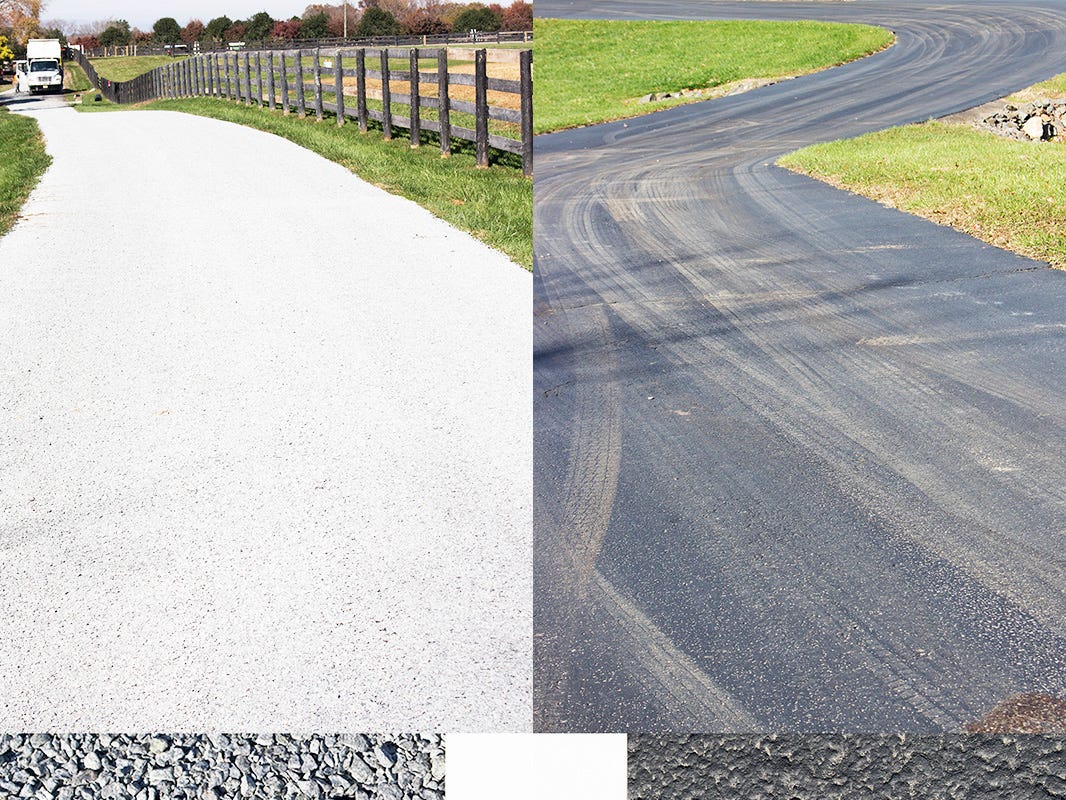
If you chose the light colored driveway in answer to Question 1, you are correct. Sunlight reflected back into space represents light that cannot be absorbed by the surface, warming it and thereby resulting in reradiation in the infrared where it can be absorbed by the carbon dioxide or methane in the atmosphere to enhance global heating. As to the second question, the difference on the scale of a single driveway is so small as to be practically immeasurable, but if done by most homeowners, it would definitely help. So, if you are thinking about resurfacing your driveway, please be mindful of the consequences of your choices. If you are in a position to influence the knuckle draggers of your local department of transportation, kindly implore them to start adding reflective coatings on the asphalt used to pave roads, to reduce the contribution of paving material to global heating.
Measures such as using light colored paving or roofing materials are examples of what is known as albedo enhancement. Albedo is a term coined by astronomers, referring to the overall reflectivity of a planet. Some of the albedo-enhancing measures being discussed have either unknown or dangerous side effects, while others, like those discussed here, are beneficial. Be careful to distinguish between them! In a later post, I will discuss albedo enhancing measures of other ilk.
There are several other things homeowners can do to increase the albedo of the planet. In addition to paving their driveway with highly reflective material, there are also the actions of
Not paving the driveway at all, or at least narrowing its width as much as possible. Even grass or bare soil is better for the planet than black asphalt;
Taking reflectivity into account when re-shingling your roof. Lighter colors are better than darker ones. Consider adding some solar panels too;
Rewilding most of the yard area devoted to lawn, or at very least setting the blades of your lawn mower to allow the grass to grow as tall as possible. Rewilding, as for example planting a wildflower meadow, not only results in less heating of the earth's surface but also benefits wildlife, encouraging and protecting biodiversity1;
Increasing the number of trees on your property. Foliage is a good reflector of sunlight, and shaded ground is cooler than sunlit ground. If possible, plant deciduous trees to the south and west of the house to place the house in shade during the summer. Doing so provides a measure of passive solar heating (in the winter, when the trees are bare) and cooling (in summer, when the trees shade the house). Deciduous trees are also significantly superior to conifers in sequestering carbon. Oh, and by the way, use those fallen leaves as mulch instead of burning them;
Engaging an attorney to explore suing your local homeowner's association if their senseless regulations prohibit any of the foregoing, and petitioning your local government to prohibit homeowners associations from imposing environmentally damaging regulations.
n conclusion, allow me to remind you of what my fellow terrorist Greta Thunberg said: "No one is too small to make a difference."
Appendix: The Greenhouse Effect
It has been known for some centuries that all warm bodies lose heat to their cooler surroundings via, inter alia, a process called radiation. Scientists struggled to understand the phenomenon, and by the middle of the 19th century it came to be understood that the mechanism by which warm bodies radiate involves electromagnetism, hence the term electromagnetic radiation. Various theoretical treatments of the subject led to the invention of the concept of a blackbody, which is an object that absorbs all the radiant energy impinging on it. So, a mirrored ball for example is not a very good blackbody, but as it turns out both the sun and the earth are very good ones. Without getting into details concerning all the theoretical failures to predict the radiation characteristics of blackbodies, it was Max Planck who, by inventing the successful model of blackbody radiation at the turn of the 20th century, paved the way for the inevitable development of quantum mechanics. All you need to know about the Planck radiation law are the following:
The shape of the curve relating the amount of energy emitted per unit area to the wavelength of the emitted energy depends ONLY on the absolute temperature of the blackbody;
The peak of the curve shifts to shorter wavelengths as the blackbody temperature increases;
A warmer blackbody emits more energy per unit area than a cooler one at ALL wavelengths; and
The law has been found to be precisely accurate over a more than four order of magnitude range of temperatures ranging from the Cosmic Microwave Background at 2.7K to young class O stars at over 30,000 K.
The sun behaves as a blackbody at a temperature of approximately 5800K, while the earth behaves as a blackbody at a temperature of about 255K. Were one to plug those values into Wien's law (the mathematical representation of item 2 above), one would find that the solar peak is at a wavelength of 0.50 micrometers (aka microns, abbreviated μm), corresponding to the wavelength of maximum visual sensitivity2, while the terrestrial peak is at 11.4 μm, in the mid-infrared. Now, here's where the greenhouse effect comes from. The gasses that comprise the earth's atmosphere do not absorb light in the wavelength regime in which the earth receives the overwhelming majority of its solar radiation, but gases such as carbon dioxide (CO2) and methane (CH4) are very strong absorbers of radiation in the mid-infrared3. Thus, when sunlight impinges on the earth's atmosphere, around 80% of it is transmitted. Light reaching the surface is absorbed then reradiated, but the atmospheric CO2 and CH4 absorb some of that radiant energy. When that energy is in turn reradiated, about half of it is radiated downward, resulting in further heating of the earth's surface. Incidentally, ordinary glass has somewhat similar properties, so if someone tells you they don't believe in the greenhouse effect, take them to a greenhouse.
It should go without saying that one does not apply herbicides or insecticides or use synthetic fertilizers.
Further evidence of evolution
And, fortunately, Ozone is a strong absorber in the ultraviolet.
Even as a prime example of not a scientist I can appreciate all the knowledge you share here. Which is why in sending it on. Thank you