
Limitations on Strategic Nuclear Weapons
US Policy: Ergodic? Markovian?

Some describe Donald Trump's negotiating style as “strategic uncertainty” but the terminology I would employ is rather more esoteric, belonging to the realm of certain statisticians, physicists and electrical engineers. Since this Substack seeks to avoid needless technicality, let's use an analogy that should be familiar to anyone: The pre-Starlink appearance of the moonless night sky. Looking up, our imagination or our education may lead us to visualize stick figures in the sky, drawings of animals or people or objects, i.e., constellations.[0] But those relationships we conjure up are figments of our imaginations; there is no relationship among the individual stars in any constellation; were we to inhabit another planetary system, even one of a nearby star, the patterns would be different. Bearing that in mind, let's examine the statements and actions of Donald Trump vis a vis strategic arms limitation treaties, also understanding that the one and only treaty limiting us and the Russians is due to expire on 6 February 2026. An earlier post [1] outlined a number of arms treaties; excellent overviews as well as details are to be found on the Arms Control Association web site [2], [3].
During his first presidency, Donald Trump expressed hostility toward the idea of extending the New START treaty, which is the latest in a multi-decades long series of increasingly restrictive nuclear weapons agreements between the US and the Russian Federation (and its predecessor the USSR). This behavior closely aligned with recommendations of the Heritage Foundation [4]. Trump spoke of a desire to negotiate a strategic arms treaty involving the US, Russia and China, but there was no progress. He even refused to exercise a provision of New START allowing for a five year extension. When Trump left office in January 2021, the treaty had less than one month before expiring. Joe Biden exercised the extension shortly after his inauguration.
As a result of stiff western sanctions, freezing of Russian assets, and (limited) western military support for Ukraine following Russia's second invasion of the country in 2022, Putin announced an unwillingness to pursue negotiations of a follow-on to New START. Thus no progress was made during Biden's presidency.
The Heritage Foundation has long favored nuclear weapons, and their Project 2025 roadmap continued that stance by calling for new kinds of such weapons, ramping up the production of key bomb components, a return to nuclear weapons testing, and elimination of non-weapons programs from the nuclear weapons labs to allow for more nuclear weapons projects. [5] That they have long advocated for strategic missile defense programs like SDI could have been a factor in Trump's decision to launch the “Golden Dome” missile defense project, which will have the immediate effects of discouraging the Russians and Chinese from engaging in strategic arms reduction talks and moreover will encourage them to build up their arsenals to overwhelm any capability Golden Dome eventually achieves. [6]
Possibly unaware that he was contradicting himself, Trump told reporters on February 13, 2025, “There’s no reason for us to be building brand new nuclear weapons. We already have so many, You could destroy the world 50 times over, 100 times over. And here we are building new nuclear weapons, and they’re building nuclear weapons. . . .We’re all spending a lot of money that we could be spending on other things that are actually, hopefully, much more productive.” [7]
If indeed this statement could be interpreted as a desire on Trump's part to negotiate a follow-on strategic arms control agreement, it was quickly contrdicted by the actions of the administration to gut the National Security Council (NSC) staff, starting in May. [8] Most of the expertise in strategic arms negotiating lies within the NSC, and the negotiation process is both complex and time consuming. For example, not counting many months of preliminary talks, it took six months of formal negotiations to agree on the terms of New START and nearly five more months to get it ratified. [9] So even had Trump been sincerely desirous of keeping a lid on the arms race, February 2025 was nearly too late to do so.
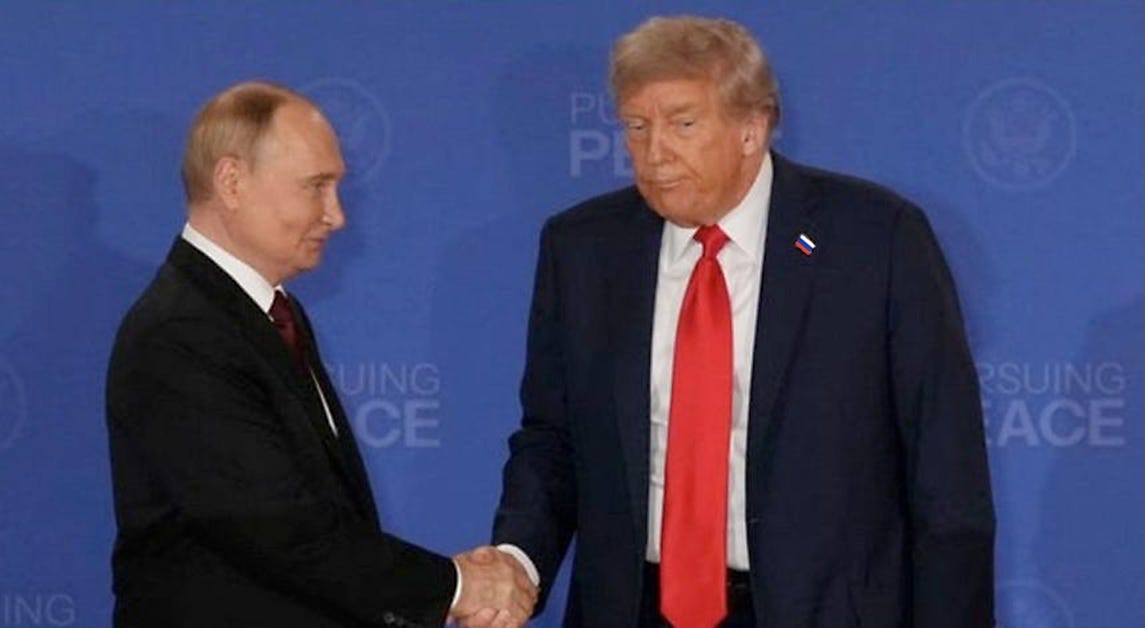
In June the administration announced a $62 Billion increase in the nuclear weapons budget. [10] Then, in a press conference on July 25, speaking about New START, Trump told reporters that “[it is] not an agreement you want expiring. We’re starting to work on that. . . . “It’s a problem for the world; When you take off nuclear restrictions, that’s a big problem.” [11] Given that statement, it would be reasonable to expect that the topic of a New START follow-on would come up during Trump’s meeting with Putin three weeks later in Аляска. But, not only did either of the “presidents” mention the treaty, but also the topic was completely ignored by the horde of “reporters”. Well, perhaps not. In an article posted on 26 August by Reuters but insofar as I am aware on none of the US MSM, “Trump said he had raised the issue with Russian President Vladimir Putin. He did not share specific details on when the conversation took place.” [12] The story was picked up by the foreign press, including that of Ukraine, with follow up to the extent of noting that the Kremlin “has not commented on Trump’s statement.” [13] So, as to the question whether Trump and Putin discussed a new nuclear weapons treaty in Аляска, the answer is uncertain. One can surmise that if there was a discussion, it had no long lasting impact on Trump because nearly a month later, on 22 September Putin “offered to voluntarily maintain the limits on deployed strategic nuclear weapons set out in the last arms control treaty between the two powers once it expires next year if the U.S. does the same.” White House press secretary Leavitt said that President Trump would address the offer himself.” [14] As of 30 September there has still been no response from the Americans [15], and the clock is ticking: 128 days to the expiration of New START.
The US, Russia and China are already modernizing and, in the case of China increasing their nuclear forces. The US modernization program is potentially capable of increasing the number of land based ICBMs alone by 1200 warheads. This will do nothing, nichts, rien, niente, nada to make anyone safer or positively influence the outcome of the nuclear war which will eventually take place. Congress, which bears a healthy portion of the blame for the path we are currently pursuing, could take action to rein in the madness by reining in our own strategic weapons programs and by insisting on immediate negotiations to reduce nuclear weapons arsenals. But that can only happen as a result of massive outpouring of opposition from their constituents.
Then again we can call on the master of the deal to solve the problem that his main supporters are so keen on enlarging:
I promised that I would constantly remind my readership of the need for everyone who believes in freedom and democracy to behave in accordance with those beliefs, every day. To remind ourselves of what that means, see
https://snyder.substack.com/p/on-tyranny-free-resources
Notes
[0] Something I emphatically recommend, and a wonderful family activity if there are pre-teens in the household. You don't need any equipment aside from a red light and a good guidebook, of which there is but one worth using: The Stars – A New Way to See Them, by H.A. Rey.
[1] https://stephenschiff.substack.com/p/treaties-and-programs
[2] https://www.armscontrol.org/factsheets/treaties-at-a-glance
[3] https://www.armscontrol.org/treaties
[4] https://www.brookings.edu/articles/the-trump-administration-and-nuclear-arms-control-treaties/
[6] Moric, I., Dome of Delusion: The many costs of Ballistic Missile Defense, Arms Control Today, June 2025 https://www.armscontrol.org/act/2025-06/features/dome-delusion-many-costs-ballistic-missile-defense
[7] Ruiz, L. and G. Wilson, What Trump got right about nuclear weapons – and how to step back from the brink, Bulletin of the Atomic Scientists, February24, 2025 https://thebulletin.org/2025/02/what-trump-got-right-about-nuclear-weapons-and-how-to-step-back-from-the-brink/
[9] https://en.wikipedia.org/wiki/New_START
[10] Liang, X., Trump Administration Increases Nuclear Weapons Budget, Arms Control Today, July/Ausust 2025 https://www.armscontrol.org/act/2025-07/news/trump-administration-increases-nuclear-weapons-budget
[11] Liang, X., et al., Trump, Laureates Agree: New START needs a successor, ACA Nuclear Disarmament Monitor, July 25, 2025 https://www.armscontrol.org/blog/2025-07-24/trump-laureates-agree
[13] https://kyivindependent.com/trump-says-he-discussed-russias-nuclear-disarmament-with-putin/
[15] https://tass.com/world/2023225 also indicates that the extension would be for one year.