
Nuclear Bunker Busters
Only danger is certain
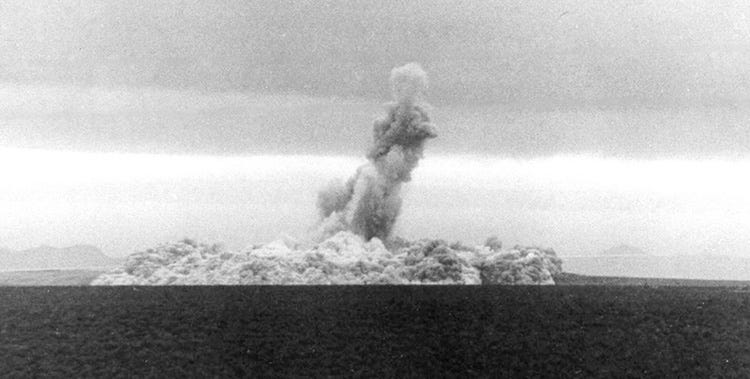
By now the story of the US strikes on Iranian underground nuclear facilities has evolved from claims of total destruction to various estimations of the number of weeks or months that will be required for Iran to recover from the damage; from claims that the Iranian stockpile of 60% enriched Uranium had been obliterated to suspicion that it was entirely undamaged. Given the Administration’s proclivity for lies and unfounded boasts, this was in a sense to be expected. But the theatrics in this case obscure the fact that attacking deep underground facilities, aka “bunker busting” is an enterprise fraught with uncertainty. Assuming the Administration remains incapable of admitting mistakes and hence learning from them, it is not imprudent to anticipate that they will seek to destroy the Iranian enrichment facilities and enriched Uranium stockpile by other means. Given that not even Trump is stupid enough to invade Iran, this motivates the development of a bigger, better bunker buster. And the biggest, if not “bestest”, bunker buster would have a nuclear warhead. The remainder of this post is devoted to the proposition that nuclear bunker busting is not a good idea.
The distinction between a bunker buster and a conventional munition is that bunker busters are designed to penetrate the ground before exploding. If for instance the device explodes in the air or very close to the surface, virtually all of the energy released will be dissipated into the air. (Think about bomb shelters.) Penetration of the surface is required to couple the energy of the explosion to the ground. If the penetration depth is sufficient, coupling is complete (Coupling = 100%) and all the energy is expended underground. As a general rule, the greater the explosive yield of the device, the greater the penetration depth required to achieve complete coupling. To see the implications of this, we first note that the magnitude of some effect of an explosion, for example a particular degree of over pressure, scales range-wise with the cube root of yield. In other words, if a 2 ton yield explosion results in a specified effect at X meters distance, increasing the yield 500 fold to one kiloton would increase the distance by a factor of (1000/2)1/3 = 7.94 to 7.94X, assuming complete coupling in both cases. If the two explosions took place at a depth such that the lower yield weapon was just completely coupled, the larger would not be; if the larger was (hypothetically) 10% coupled, the distance factor would be only 3.68, in other words replacing the 2 ton conventional warhead with a 1 kiloton nuke would increase its effective radius by only 46% of the fully coupled value. Were we to further increase the yield of the weapon without increasing its penetration depth, the degree of coupling would get worse. The penetration depth for a given munition depends on the ground properties which are not known with certainty, and since the coupling also depends on the ground properties, there is inherent uncertainty concerning the effectiveness of the weapon.
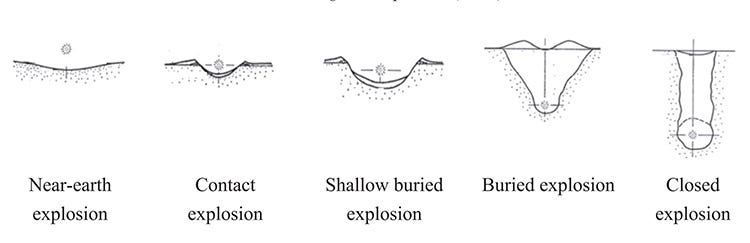
Given the need to penetrate the ground to sufficient depth to achieve very high or complete coupling, the questions become those of design and prediction. Penetration depth is maximized by making the weapon as long, massive, dense, and mechanically strong (in terms of yield strength) as possible. From that point onward it becomes very complicated both in terms of nuclear explosion yield and impact velocity.
A first principles approach tells us that the munition needs to have energy to penetrate the ground, so one expects that the potential penetration depth scales like the square of the projectile velocity at impact. (That’s because the kinetic energy of the projectile is ½mv2, where m is its mass.) But one cannot simply increase the velocity, because what happens upon impact and thereafter depends on the material characteristics of both the penetrator and the target. There are a number of penetration models [2], applicable according to the penetration regime [3], even assuming ideal conditions [4].
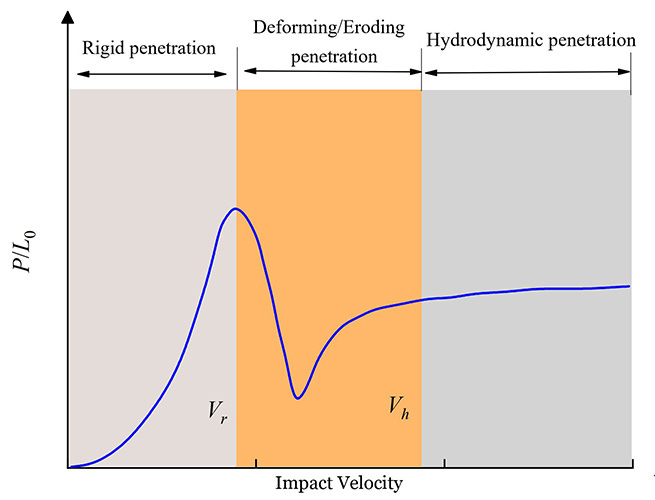
The figure above illustrates the penetration behavior of a projectile having some particular material properties impacting a target having its own particular material properties. There is clearly an optimum velocity for each pair of property sets. The fundamental problem is that we do not know the target properties in sufficient detail to optimize the penetrator velocity, and need to be aware that making the penetrator go too fast can have devastating effects on penetration depth. Incidentally, the ordinate on the chart is measured in terms of penetration depth (P) divided by penetrator length (L0) so one way to achieve a greater penetration depth is to make the penetrator longer. [5]
To estimate the penetration capability of an hypothetical nuclear bunker buster I took the approach of modeling it in terms of the GBU-57 Massive Ordnance Penetrator (MOP) currently in service in the US Air Force. A nuclear version is extremely unlikely to be longer or more massive than the GBU-57 because a bigger one would require either development of an entirely new aircraft or extensive modifications to the B-52; neither the current GBU-57 platform (the B-2) nor the anticipated one (the B-21) could accommodate a significantly larger weapon. Unfortunately the available performance data for the GBU-57 [6], [7] are extremely noisy. Based on using the Poncelet equation [8] I conclude that the 61 meter penetration depth quoted by the Air Force must refer to a soil target (as though soil depths of 200 feet were common!) and other quoted figures (18 meters into 34 megaPascal (MPa) concrete and 2.4 meters into 69 MPa concrete) are inconsistent because penetration depth should scale linearly with strength. Given that a large variety of rock materials (including Basalt, Gneiss, Granite, Limestone, Marble, Sandstone and Shale) have average uniaxial strengths of over 90 MPa [9], it is safe to assume that the penetration depth for the GBU-57 is less than 20 meters for targets buried under rock. Calling your attention to the figure at the top of this post, we can be assured that a nuclear version of the GBU-57 would offer but a modest improvement in performance as compared to the conventional version now in service (cf., “Shallow buried explosion” in the second figure).
Please note that a penetration depth of 20 meters does not imply the inability to damage or destroy targets at far greater depth, for the shock wave from the explosion can collapse cavities at considerable distances, and damage vibration sensitive equipment still farther out. The focus on penetration depth has to do with effectively coupling the explosive energy to the ground.
The most important point: Not only would the use of nuclear bunker busters represent the normalization of nuclear weapons, breaking a taboo that has been respected by every country on the planet since 1945, but it would also inevitably result in the release of massive quantities of radioactive material into the atmosphere [10]. Unlike an underground nuclear test, where the weapon is set off at great depth and extensive efforts are made to prevent venting, a nuclear bunker buster explosion is by definition vented and occurs at an inherently shallow depth. Innocent civilians in the targeted country and downwind neighboring countries would be harmed.
I promised to constantly remind my readership of the need for everyone who believes in freedom and democracy to behave in accordance with those beliefs, every day. To remind ourselves of what that means, see

Notes
[1] Guo, W., et al. (2024) Theory and test of underground explosions: Coupling rule between cratering and ground shock. Underground Space 17, 146-160 https://doi.org/10.1016/j.undsp.2023.11.010
[2] Charles E. Anderson, Jr. (2017) Analytical models for penetration mechanics: A review. International J. Impact Engineering 108, 3-26 http://dx.doi.org/10.1016/j.ijimpeng.2017.03.018
[3] Xu, H., et al (2025) On the Penetration of Projectiles into Semi-Infinite Concrete Targets in a Coupled Deforming and Eroding Regime. Buildings 2025, 15, 1607. https:// doi.org/10.3390/buildings15101607
[4] Ideal conditions include the assumption that the penetrator path intersects the ground at a right angle, e.g. vertically for a horizontal surface. If the angle is significantly different, the path of the penetrator will be deflected, and – far more importantly – the dynamics of the penetrator-target interaction will be degraded, shifting the boundary between penetration regimes to lower velocities. The vertical incidence assumption is challenged by mountainous terrain (think Fordo) and can be falsified by design on the part of the defenders.
[5] That is part of the reason why shaped charge munitions achieve such great penetration depths. Though operating in the hydrodynamic penetration regime, the liquid metal jets achieve extraordinary lengths.
[6] Zanotti, J., et al. (2012) Israel: Possible Military Strike Against Iran’s Nuclear Facilities, Congressional Research Service, R4223, https://nsarchive2.gwu.edu/NSAEBB/NSAEBB439/docs/doc_62.PDF This document is worth perusing to inform an historical perspective on Israel’s efforts to involve the US in a war against Iran, and how Iranian responses were accurately predicted more than a decade ago.
[7] Wikipedia (2026) GBU-57A/B MOP, https://en.wikipedia.org/wiki/GBU-57A/B_MOP
[8] As always, I am happy to share the details of my calculations with any paid subscriber requesting them.
[9] Amadei, B. (undated) CVEN 5768 Lecture Notes 8: Strength properties of rocks and rock masses, https://ceae.colorado.edu/~amadei/CVEN5768/PDF/NOTES8.pdf
[10] If one’s intention was to maximize the amount of radioactive debris released into the environment, one could do no better than by burying the weapon at shallow depth.