
Nuclear Winter Update – Part 3
Prospects
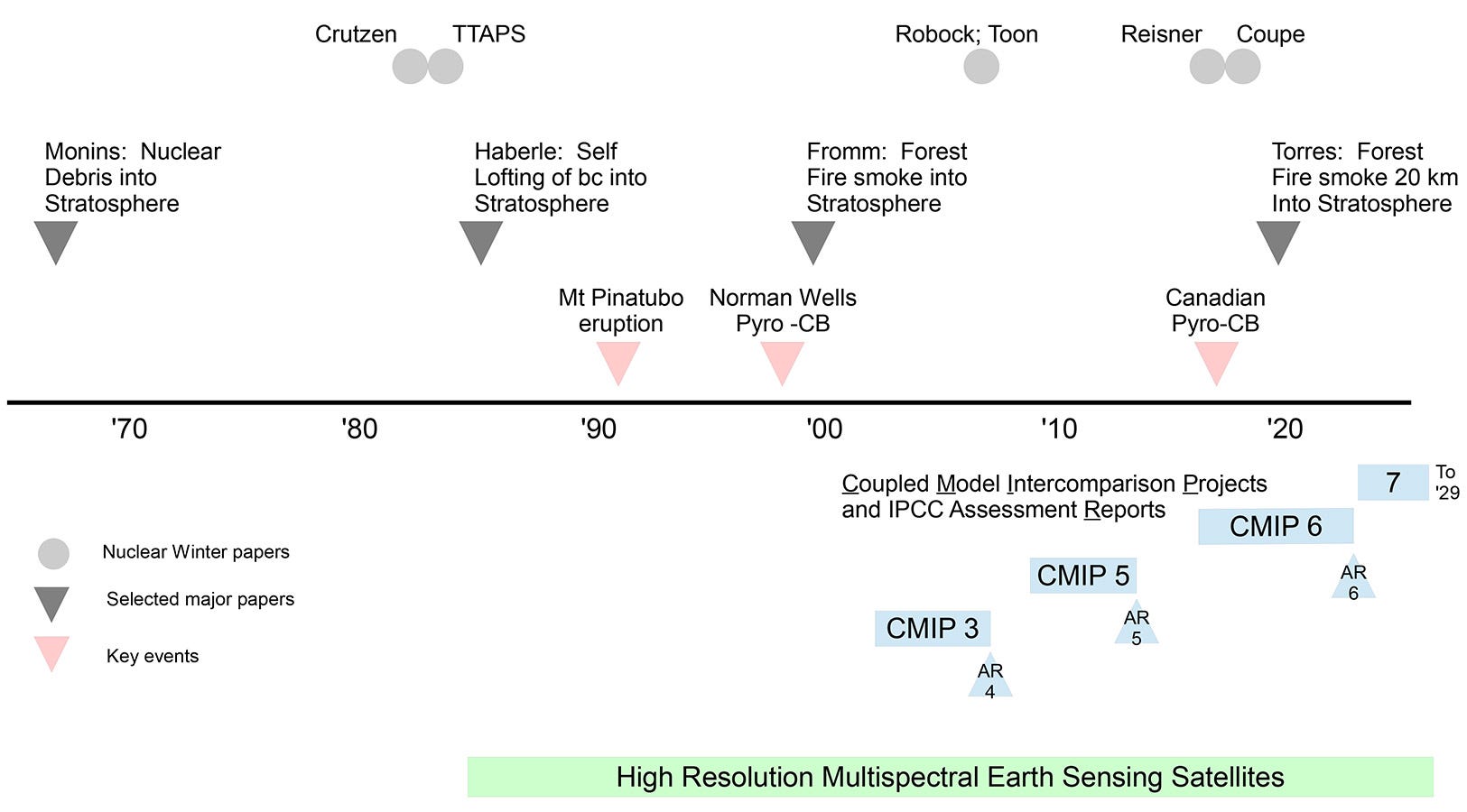
I shuddered in disappointment when I read the first line of the Preface from the long awaited National Academy of Sciences report on the environmental effects of nuclear war [5]:
“The issues raised by the possibility of effects of nuclear war on the atmosphere and climate only strengthen the basic imperative of U.S. national security policy—that nuclear war must be prevented.”
words written by Caspar Weinberger [6] in his response to the previous iteration of the study. That nuclear war must be prevented, while emphatically true, has nothing whatsoever to do with nuclear winter; the statement is a distraction. The Preface went on to quote from the DoD's 2022 Nuclear Posture Review, including this:
“. . . [T]he leaders of the five declared Nuclear Weapon States . . . affirmed that a nuclear war cannot be won and must never be fought, and that nuclear weapons should serve defensive purposes, deter aggression, and prevent war.”
which implies disavowal of the No First Use principle. Thus was I prepared for what followed.
I do not wish to convey the impression that I found nothing of use in [5]; Many of its findings and recommendations are very useful. Chief among these are
The recognition that current models for estimating the amount and composition of smoke from fires, especially in urban settings, are inadequate and need improvement;
Likewise, modeling of smoke plumes in the troposphere need further development; and
All the models used in predicting the long term effects of nuclear war need to be subjected to the discipline and collaboration embodied in the climate modeling community's Model Intercomparison Projects (MIPs) and Coupled MIPs (CMIPs).
It would have been nice to have seen words of recognition of the possibility that a nuclear exchange at some currently possible level of intensity could trigger a climate catastrophe, but, unlike in the predecessor reports of 1975 and 1985, there were none. Even the report title is misleading, as there are no statements about “Potential Environmental Effects of Nuclear War”, only about things the authors recommend doing to better study them.
The preface of my own report, should I have written one, would encapsulate half of the fatal problems with the current NAS report:
“Secrecy hides failure and exaggerates success”
which is attributed to Freeman Dyson [7]. The NAS report proposes that the nuclear weapons establishment be responsible for developing models to estimate smoke production and plume dynamics, using their own planning and assumptions regarding target characteristics in each of the nuclear war scenarios. This would by definition be an utterly opaque process, which is at odds with the very nature of science, which demands transparency. The second fatal flaw is the focus on involvement primarily by US Government agencies, which in some instances contributes to the lack of transparency problem, and which largely ignores the vast capabilities lying outside the Government, both in the US and abroad. As I noted in [2] there is but a single reference to “US global partners”, whatever that means.
To underscore the degree of the NAS' isolationism one needs only notice that more than six months prior to the issuance of the draft report, that is to say during the Biden administration, a resolution was brought up before the United Nations General Assembly, calling for the formation of an expert commission to prepare a study on the long term consequences of nuclear war. It was enacted in December 2024. [8] The NAS could have acknowledged the international effort and even encouraged collaboration. In particular they could have encouraged the US researchers to integrate into the CMIP 7 process, which has just gotten under way and will complete in 2029, but they chose to utterly disregard it.
Of the nuclear armed states, three (Russian Federation, France and UK) voted against the UN resolution, one (China) joined 143 non-nuclear states by voting in favor, and the others abstained. The 21 person commission, announced in July, has four members from the US, two from the UK, one from China and none from any other nuclear weapons state. [9] Their report is due at the end of 2027, in time to influence CMIP 7.
Here is the problem: If nuclear winter is a possibility, there is but one way to ensure that it will be averted, and that is to have a strong international consensus, involving each and every nuclear armed state, that the possibility exists and that, therefore, nuclear weapons stockpiles must be reduced to such a level that nuclear winter is ruled out. That requires transparency and an international, collaborative scientific research effort, something that absolutely cannot happen in the atmosphere recommended by the US National Academy of Sciences. Moreover, following their path will effectively deny US citizens the information we need to make intelligent choices on defense priorities.
All this having been said, there is nothing – aside from the availability of funding – to prevent the scientific community at large from developing the tools required to reduce the uncertainties regarding nuclear winter. Perhaps we can find a way to team up with the UN researchers and also leverage work on fire and plume modeling that is going on throughout the world.
We offer our best wishes to the UN commission and hope they are successful in reaching some definitive conclusions.
I promised that I would constantly remind my readership of the need for everyone who believes in freedom and democracy to behave in accordance with those beliefs, every day. To remind ourselves of what that means, see

Notes
[1] The items above the line in the figure are referenced in my earlier post [2] except for [3] – [4] which though important were not discussed due to length considerations. IPCC is the Intergovernmental Panel on Climate Change.
[2] https://stephenschiff.substack.com/p/nuclear-winter-update-part-2
[3] Coupe, J., et al., Nuclear Winter Responses to Nuclear War Between the United States and Russia in the Whole Atmosphere Community Climate Model Version 4 and the Goddard Institute for Space Studies ModelE. JGR Atmospheres 124, no. 15, 8522–43. https://doi.org/10.1029/2019JD030509 A replay of TTAPS using updated threat and modern climate models.
[4] Torres, O., et al., Stratospheric Injection of Massive Smoke Plume From Canadian Boreal Fires in 2017 as Seen by DSCOVR‐EPIC, CALIOP, and OMPS‐LP Observations, JGR Atmospheres, 2020 https://doi.org/10.1029/2020JD032579 Satellite data show soot self-lofting at least 20 kilometers above the tropopause.
[5] National Academies of Science, 2025, Potential Environmental Effects of Nuclear War (2025) http://nap.nationalacademies.org/27515
[6] Weinberger, Caspar W., The potential effects of nuclear war on the climate, 1985 https://nsarchive.gwu.edu/sites/default/files/documents/rcrn6j-upkqk/Doc-12.pdf
[8] https://www.icanw.org/un_approves_new_study_on_effects_of_nuclear_war