
Oklahoma earthquakes
A cautionary tale for CCS
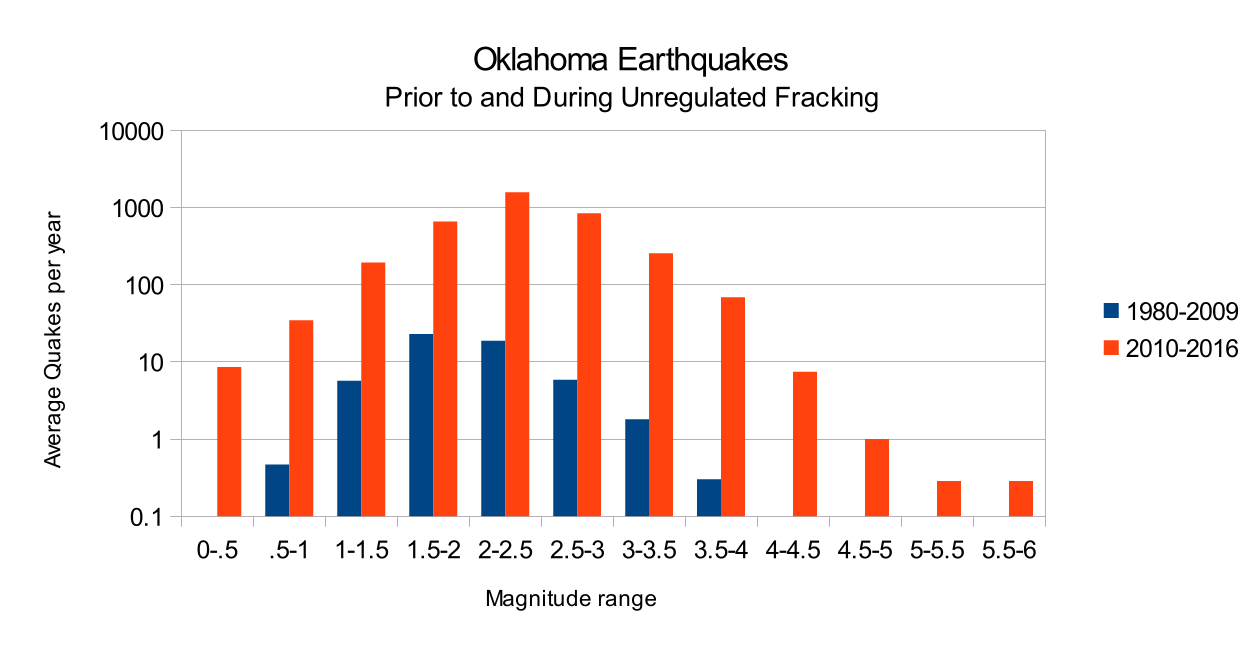
One of the key features of human enthusiasm, particularly in regard to money-making enterprises, is a profound blindness to the risks and potential adverse side effects of the object of that enthusiasm. A fine example of this trait is the use of advanced techniques such as hydraulic fracturing ("fracking") and enhanced oil recovery ("EOR") by the fossil fuel industry, along with waste water injection, all of which have been claimed to have no adverse side effects. The use of those techniques at scale in the US state of Oklahoma, starting around 2010, provides a clear example of the eventual futility of lying.
The figure at the top of the page, produced using the Oklahoma Geological Survey earthquake database [2] clearly shows how, in the period 2010 - 2016 the number and severity of earthquakes in Oklahoma increased dramatically. Later years are not included because starting in 2017 the industry's behavior started to change, and in 2018 new legal requirements in that state effectively reduced the frequency of earthquakes due to fossil fuel related operations. For those of you who don't understand logarithmic plots, the same data are plotted below using a linear scale.
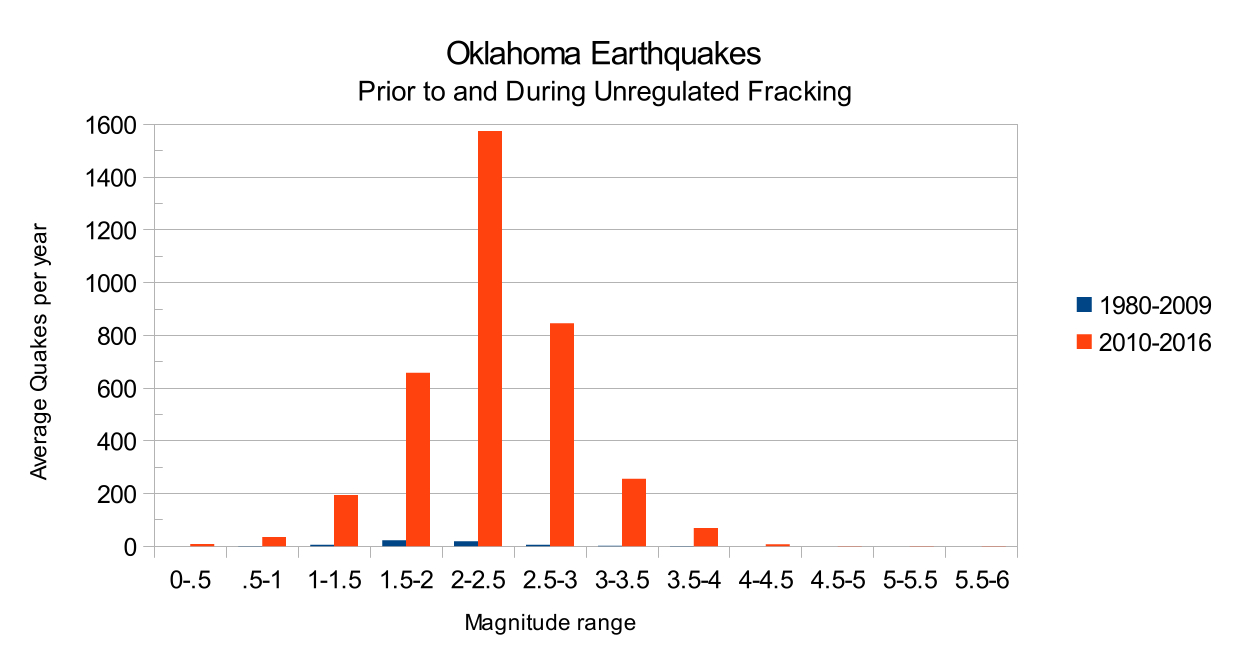
To view the numbers from a different perspective, the average number of magnitude 3 or higher earthquakes in Oklahoma increased from approximately 0.04 per week over the three decades 1980-2009 to 6.43 per week in 2010 - 2016, a 15,108% increase. Predictably, the initial response of the fossil fuel companies and the politicians they own was denial [3], and as the situation continued, the various regulatory agencies became involved as efforts to spin the obvious gained traction. It was only retrospectively (in late 2015) that scientists from the US Geological Survey did a comprehensive study [4] showing that deep waste water injection, primarily, had increased seismic activity in Oklahoma starting in the 1930s, and was correlated with the magnitude 5.5 El Reno earthquake of 1952. The USGS and OGS continue to state that deep waste water injection is the primary culprit, without mentioning other possibilities by name; in effect lying by omission. Other work [5] has demonstrated that earthquakes were associated with hundreds of hydraulic fracking sites in the state.
What does this have to do with Carbon Capture and Sequestration? Superficially, quite a lot, because the preferred method of carbon sequestration is to inject supercritical CO2 into deep saline aquifers, which shares most attributes with high rate deep waste water injection. (The difference is that supercritical CO2 has a density lower than that of the water in the aquifers, while the waste water typically has a higher density, promoting downward migration of water into a fault. [6] ) Insofar as I am aware, no studies have been performed to model the comparative seismogenesis of supercritical CO2 and waste water. One thing that is known [7], however, is that high rate injection wells (with injection rates of > 47,896 cubic meters per month [8]) are much more likely to produce earthquakes than lower rate of injection wells. This tells us that, if injection of supercritical CO2 can be modeled as being equivalent to that of waste water, CCS facilities will need to limit their injection rates to less than 22,370 metric tons of CO2 9] per well per month to reduce the risk of causing earthquakes. Now, for CCS to have a meaningful impact on climate change, billions of tons of CO2 will need to be sequestered annually. How many wells per billion tons per year, while keeping to the above injection rate restriction? Answer: 3725.
Using EPA figures for the US in 2022, a regression line was fit to CO2 emissions vs MWh for the 419 power plants for which both megawatt hours and tons of CO2 emitted were reported, and this was used to produce the results that follow. The largest coal fired power plant on the planet [10] is estimated to produce around 60 million metric tons of CO2 per year, or just over 5 megatonnes per month, which means that 224 deep injection wells, operating in parallel, would be required to safely sequester the carbon dioxide from that plant, subject to the assumed equivalence of supercritical CO2 and wastewater and the existence of a threshold injection rate, below which earthquakes are not promoted. For a global average, 350 MW coal fired plant, the number of wells to support safe sequestering via injection into deep saline aquifers is 12, and the capacity of a coal fired power plant that can be supported by a single well is 35 MW. (Round off explains the apparent discrepancies.) It is a further requirement that the wells be sufficiently well separated from each other that their effects on the subterranean aquifer can be considered independent, implying the requirement for a CO2 distribution system for all but the smallest power plants.
Notice, please, that I am assuming that injected supercritical CO2 will behave the same as waste water, an assumption without empirical support. So I am not proposing the imposition of any standards for CCS based on this post, but rather suggesting that it would be a good, perhaps even excellent, idea for some qualified, independent investigators to study the potential problems of high rate injection of CO2 into saline aquifers, with an eye toward establishing regulations to prevent CCS from causing earthquakes [11]. Certainly, there is no reason to accept the assurances of CCS advocates that geological sequestration of CO2 is inherently safe.
Notes
[1] Hence the proverb, "There are none so blind as those who will not see."
[3] This behavior was by no means confined to Oklahoma. Who can forget the videos of methane flares being lit on kitchen faucets in Pennsylvania , and how their legislature attempted to suppress the truth?
[4] https://www.usgs.gov/news/national-news-release/century-induced-earthquakes-oklahoma
[5] https://agupubs.onlinelibrary.wiley.com/doi/10.1029/2018JB016790
[7] https://www.science.org/doi/abs/10.1126/science.aab1345
[8] The number in the cited report was expressed in "barrels", which I took to mean "oil barrels", of volume 0.159 cubic meters
[9] assuming a density of 469 kg/cubic meter, corresponding to supercritical CO2 at a depth of 800 meters, the minimum depth that typically supports the temperature and pressure regime required for CO2 in the supercritical state.
[10] https://datasets.wri.org/dataset/globalpowerplantdatabase
[11] The IPCC report on CCS, https://www.ipcc.ch/site/assets/uploads/2018/03/srccs_wholereport-1.pdf issued in 2005, noted the possibility of induced seismicity, but the fossil fuel industry either failed to take notice or failed to act on it.
Reposted 19 February 2024 with formatting changes