
One trillion trees
Failing at arithmetic also
NB: This post, originally published on 8.08.23, has been reformatted to bring it into compliance with current practice and is republished per request.'
Perhaps you have heard the astounding news: the US Republicans (well, some of them, anyway) are now admitting that it might just be possible that the total disregard of the planet by disconnected humans is causing the climate to change in a bad way, and propose solving the problem by business as usual, plus planting a trillion trees. A trillion (1,000,000,000,000), aka a million million (1,000,000 x 1,000,000) is a pretty incomprehensible number, even for those who dabble in cosmology or big data. The idea of planting a trillion trees is a good one, no doubt about it, but it immediately raises four questions:
Is there any practicable way of actually doing it?
How much would it cost?
Will doing it solve the problem of anthropogenic climate change?
Who will pay for it?
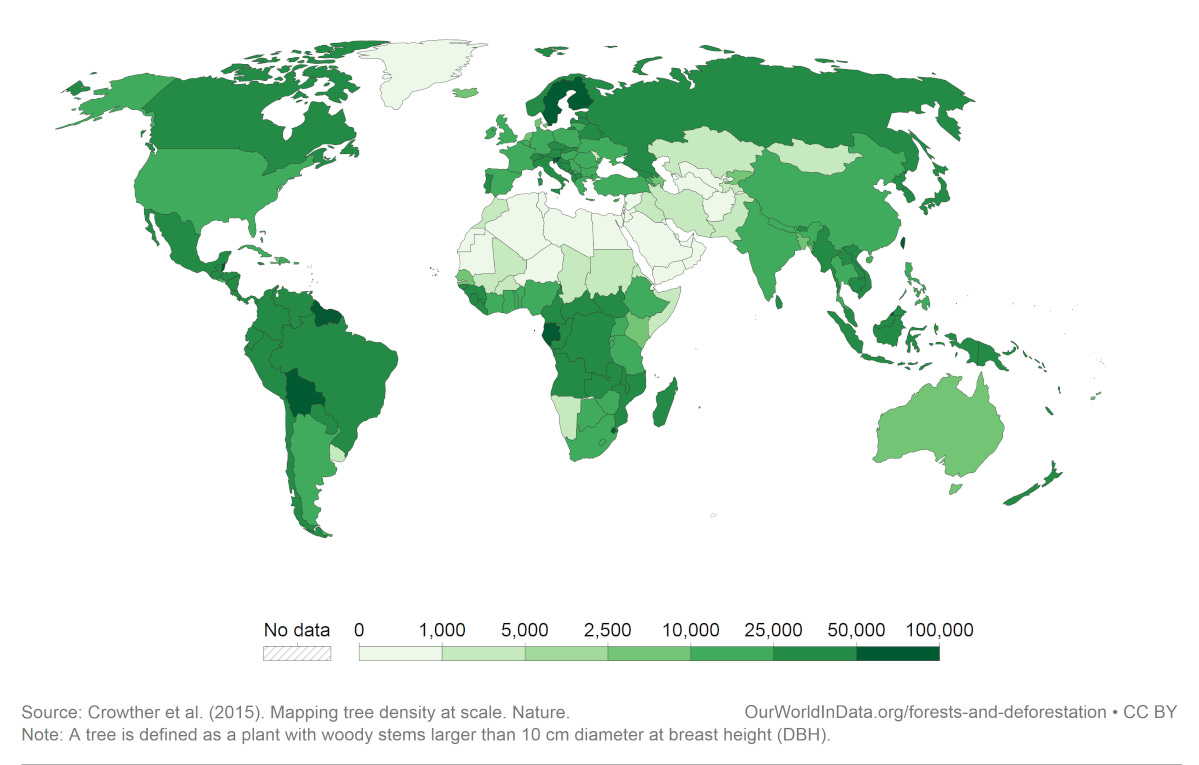
As the map shows (quantitatively on their web site) the number of trees per square kilometer varies from 1 (in Saudi Arabia) to 72,644 in Finland, with a worldwide average of 22,540 trees per square kilometer in 40.88 million square kilometers of forested land. Multiplying these two numbers together we get an estimate of 922 billion trees; an alternative method yields 1.3 trillion, so, estimate that the world's forests all together are the home to about a trillion trees. In effect, then, the proposal is to double that.
One way to plant a trillion trees would be for the USA to do it alone. Per the source cited, the forests in the US have an average density of 24,087 trees per square kilometer. If we were to plant a trillion trees with that density, it would require allocation of 41.52 million square kilometers in addition to the 3.1 million square kilometers already in forest. Unfortunately, the land area of the US is less than a quarter of that. So going it alone is not a viable option.
This other way to plant a trillion trees would make allocations to all countries based on some measure of their suitability for afforestation. Not to dwell on the obvious, but such a scheme goes against a key element of the MAGA Republican agenda, which is for the US to eschew multinational agreements, especially any such agreement which includes obligations, much less penalties for noncompliance. As one can see from the map, not all regions of the planet would be suitable for planting forests; the Sahara, Sahel and Middle East, for examples. Countries in such regions would have to be excluded. If the participating countries were assigned areas in proportion to their existing forested areas, with the expectation that the afforested areas would be populated in accordance with existing forestation, then on the average countries would have to increase the size of their forests by 58.4%, with the largest increase being 222%. The US would have to increase its forested area by just over 113%, an added area about ten times that of the state of Texas. The European Union recently passed legislation requiring member states to restore 20% of their land and waterways, a move strongly opposed by industrial agriculture. Some EU member states have expressed concerns that the 20% figure will be unachievable, which bodes ill for the tree planting proposition.
Then there are the logistics, leading to cost. It is safe to posit that the sudden demand for a trillion trees would severely disrupt the supply chain. The US-based Arbor Day Foundation [2] boasts to having planted 500 million trees in the past 50 years, and has an ambitious plan to plant another 500 million in the next five. It would take 2000 replications of their plan to supply a trillion trees in five years. How is that to be accomplished, and at what administrative cost? How much does it cost to plant and nurture the trees? It would be misleading to use something like the (nonprofit) Arbor Day Foundation's bulk price of $79 per 50 fast growing deciduous trees as a total cost estimate, not only because of the disruptive scale but also because that price does not include the preparation and planting process and the necessary tending for at least a few years afterwards. Hazarding a guess of ½ hour per tree at the average OECD minimum wage labor rate [3], a rough project cost estimate is $9 Trillion, not including administrative expenses and worker benefits, and assuming no more than tripling of the aforementioned tree price, with minimal needs for tree replacement and incidentals.
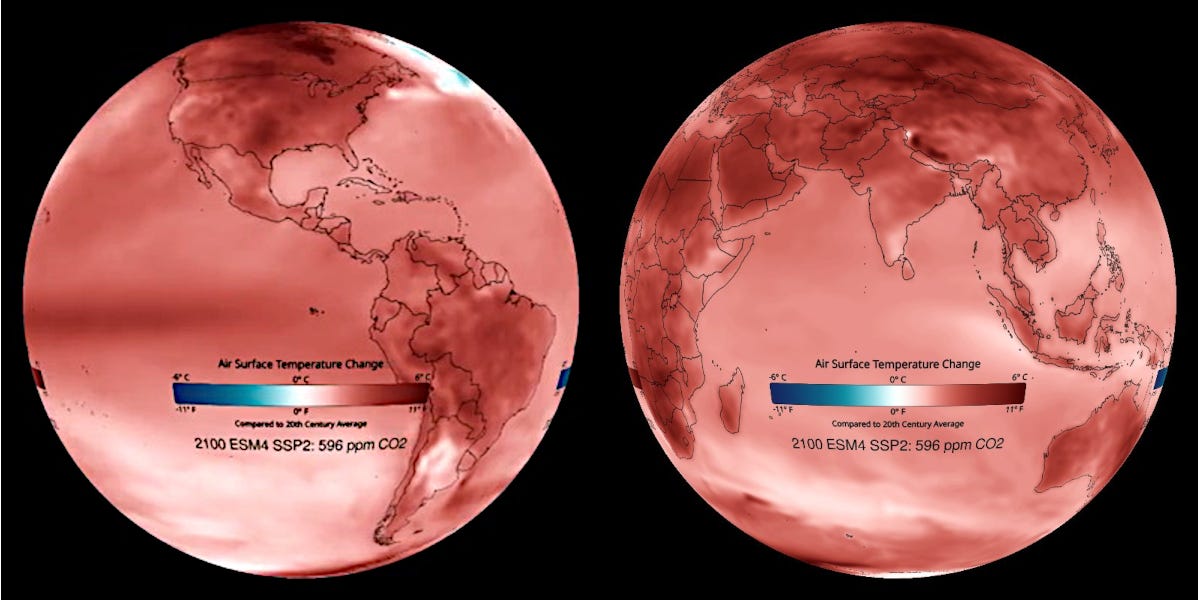
Now to address the third question: If we did it, would it solve the problem? Per the EPA [4] the CO2 annual sequestration for US forests varies from 616 tonnes per square kilometer per year for the mostly coniferous forests of Alaska to 2130 tonnes per square kilometer per year for the tropical rain forests of Hawaii, with a national average of 1122 tonnes CO2 per square kilometer per year. Taking this to be indicative of the planet as a whole, we see that planting a trillion trees with 22,540 trees per square kilometer - 44.37 million square kilometers in all - would eventually achieve a CO2 sequestration rate of 49.8 billion metric tons per year [5]. Per Our World in Data [6], in 2021 the world total CO2 emissions due to fossil fuels and land use change stood at 41.06 billion tonnes, so notionally the afforestation project would reach a slight degree of CO2 negativity, assuming that the rate of emissions does not increase. What that would mean in practical terms is optimistically [7] predicted in terms of the IPCC's SPP2-4.5 scenario which is based on the assumption that net emissions will continue at the present level until 2050 then decline to net zero in 2100. NOAA's Geophysical Fluid Dynamics Laboratory's ESM4 model's prediction of global surface temperatures [8] at that time are shown in the figure below. Note that full scale is +6C, and that +1.5C is near white in the color range. In words: The proposed approach utterly fails to limit heating to 1.5C, promising to make the effects of climate change much worse before stabilizing at an intolerable level.
Regarding the fourth question (Who pays for it?), the answer, obviously, is: Us. It would be nice if everyone understood that we, the 99%, will pick up the tab one way or the other, either by paying money in the short term to achieve climate justice and avoid future damage or by paying much more money and experiencing the pain and suffering that results from postponing the inevitable.
Notes
[1] https://ourworldindata.org/grapher/number-of-trees-per-km
[3] https://stats.oecd.org/Index.aspx?DataSetCode=RMW
[5] By "eventually" is meant after sufficient passage of time for the trees to achieve full maturity. Perhaps by the end of the century if we planted right away.
[6] https://ourworldindata.org/co2-emissions#global-co2-emissions-from-fossil-fuels-and-land-use-change
[7] Optimistically in the sense that emissions are currently increasing, and recent policy decisions by the US and UK governments regarding oil and gas leases promise to continue that trend.