
Small Modular Reactor Update
Aye Yai Yai, Help for AI?
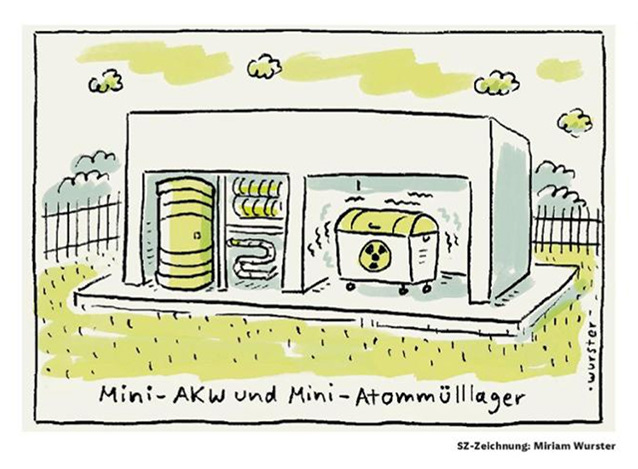
This post is an update on one of my earlier posts on small modular reactor (SMR) development and production [2]. Incidentally Miriam Wurster’s cartoon’s main inaccuracy is that many if not most SMRs have no plans for Atommüllagern. Briefly a SMR is a Small (meaning 5- 300 Megawatt [3], as opposed to large, 1000 Megawatt and up), Modular (meaning comprised of identical parts, built in series, like cars in a factory, to realize economy in production), nuclear Reactor. The Chinese ACP-100, at 125 MW, became the world’s first operational land based SMR in late 2025.
Here’s a picture of it during construction
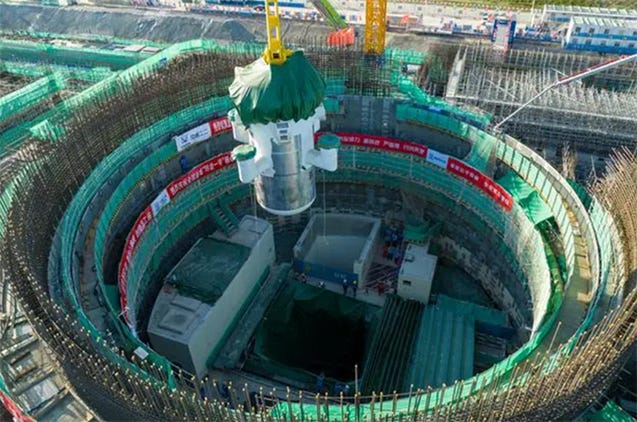
To appreciate the scale, look carefully at the picture just below and to the right of center, where two men wearing white hard hats are standing. From this photo we conclude that the non-modular portion of this SMR is not especially small and that construction doesn’t happen over night. The Chinese brought this ACP-100 on line just 58 months after breaking ground. (Keep that in mind.) Incidentally a contributing factor for the large size is that they enclosed the reactor in a containment structure for safety. No fools, the Chinese.
Ch. 1: Recent Developments.
By way of a preface, in conducting research for this post I happened across a number of articles written for investors, which led me to at least one insight, that I will share later. In most cases, I found the material to be ill-informed at best but there was an exception that will be highlighted below.
In May 2025 the Trump administration issued an executive order aimed at speeding up the design and safety review processes for new nuclear power plants. Though this might be seen as part of the Project 2025 agenda for neutering the government, it is possible that there was a more personal reason, as will become clear in my next post.
The review process was codified in the Department of Energy’s new Standard 1271-2025. [4] The Introduction makes it clear that the priority is on rapidly approving projects with the objective of “achieving criticality in each of the [minimum of three newly approved] reactors by July 4, 2026”. Reading through the document, one must conclude that the regulatory framework is entirely negotiable, a fact explicitly stated with regard to design in Section 3. In Section 6, it is noted that the regulatory process represents “a streamlining of past DOE expectations in that it eliminates precursor steps to a PDSA. ” (PSDA: Preliminary Documented Safety Analysis.) The standard lists the steps and documents produced in the design process, then lists the specifications and standards for those efforts. However, preliminary to each topical list, there is the following statement: “The Contractor may choose to include the requirements listed below or propose to utilize an alternative industry or other regulatory body standard.” In other words, everything is negotiable.
Since I published [2], the SMR community has expanded worldwide; in reviewing articles for the period June-December 2025 at the World Nuclear News website, I counted 26 countries apart from the US that are somehow involved in acquiring SMRs. This post focuses on the US alone. Here, there are two new major players: OKLO and Deep Fission. Both are among the ten candidates selected by the DOE for accelerated approval and demonstration.
OKLO is developing a molten Sodium cooled, fast reactor that is claimed to be capable of using spent fuel. It had failed to gain approval for its design in the early 2020s but gained new life when Sam Altman agreed to serve as board chairman. Citing conflicts of interests (!) Altman withdrew in the summer of 2025, and the company’s stock price has plummeted since then. I recommend the Forbes article [5] as a rare insightful look at the SMR market and a source of perverse amusement. Caveat: I am not a financial professional, and nothing I say or write should be taken as financial advice.
Deep Fission is so named because their concept involves drilling one mile (1610 meter) deep, 30 inch (76.2 cm) diameter bore holes and inserting conventional water cooled reactors at depth. Pipes attached to the reactor bring steam to the surface to run steam turbine generators and return the condensate to the reactor. When the fuel is expended at the end of seven years, the hole is either sealed or another reactor is emplaced above the spent one, a process that they claim can be repeated a total of six times, provided the initial hole is bored to such depth that the seventh reactor is a mile beneath the surface. The claim is that the depth provides adequate safety in the event of an accident, and that in such an event there is no possibility of radioactive material venting into the atmosphere or aquifers! [6]
Ch. 2: State of Other Players in the US.
In researching for this section I consulted the World Nuclear News website [7] as well as the corporate websites for each of the following SMR developers: TerraPower, NuScale, OKLO, Deep Fission, Kairos, X-Energy, and the HOLTEC subsidiary SMR LLC. In each case I found indications of plans to achieve criticality in demonstration plants within a short time, but great vagueness regarding prospects for commercialization. At best, there are promises to bring their first commercial reactor online by 2030.
Ch. 3: Outlook.
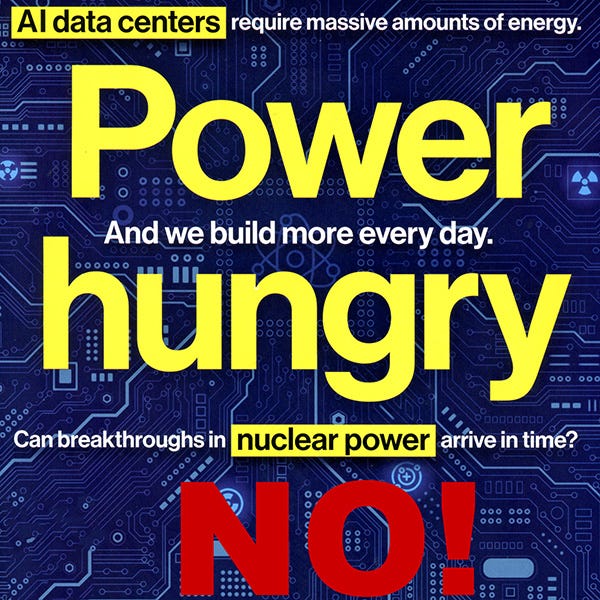
SMR companies have received a big boost from the current AI [sic] bubble, with many efforts to cash in on the boom in data center construction. A recent cover story in MIT Technology Review asked whether breakthroughs in nuclear power can arrive in time to meet the electricity needs of AI data centers. I have taken the liberty to annotate their cover illustration with the answer, in red.
Here are the numbers. According to the IEA, as quoted by the Pew Research Center [8] US data center annual electricity consumption increased from 108 TWh to 183 TWh (TWh, terawatt hours. 1 TWh = 1 million MWh) from 2020 through 2024, and is projected to be 426 TWh in 2030. A 50 MW SMR can produce 0.438 TWh annually, so to simply meet the increase in demand by AI data centers we would need to deploy 555 ea, 50 MW SMRs by 2030. How many SMRs will we deploy? ZERO.
Incidentally the 2024 figure represented 4% of US electricity consumption, and the state by state fractions varied. In Virginia, the 643 data centers consumed 26% of the electricity. Given the eviceration of clean energy projects by the Trump administration, electricity prices will continue growing, at least until the AI bubble bursts.
Next, a speculation as to the reason for the nebulous nature of SMR firms’ specifics regarding time lines to full commercialization: It is to avoid scaring off potential investors. The industry needs copious injections of cash over as much as another decade to reach the point of developing revenue streams based on actual sales. Most investors don’t want to wait that long. And lastly, considering the dangerous relaxation of regulatory oversight of new nuclear power concepts and the throttling of clean, safe and sustainable energy in the US, you may possibly be sensing a grift. Bear that in mind for my next post.
I promised to constantly remind my readership of the need for everyone who believes in freedom and democracy to behave in accordance with those beliefs, every day. To remind ourselves of what that means, see

Happily, the good people of Minnesota have gotten the message.
Notes
[1] Süddeutsche Zeitung (2026). Jg. 226 Nr. 4, S.4
[2] https://stephenschiff.substack.com/p/new-generation-reactors-part-2-230
[3] Megawatt (MW) = 1 million Watts. The Watt is a measure of the rate of energy production or consumption, on a per second basis. Power plants are also rated in terms of energy per year. At a rate of 1 Watt, the amount of energy in a year is 1 W x 24 hours/day x 365 days/year = 8670 Watt hours, or 8.67 kilowatt hours (kWh) per year, if operated continuously.
[4] U.S. Department of Energy (2025). DOE-STD-171-2025: Authorization Pathway for Nuclear Facilities, August
[5] https://www.forbes.com/sites/greatspeculations/2025/12/02/is-oklo-a-14-billion-paper-reactor-bubble/
[6] https://www.kosu.org/energy-environment/2025-12-22/kansas-will-get-the-worlds-first-mile-deep-nuclear-reactor-30-miles-from-oklahoma-border I am at loss for where to begin my criticism of this project.
Thank you for assimilating all the news and facts about SMRs. The number needed and the recklessness with which they will be built is frightening. I wonder if the doomsday clock folks considered this in their update announced yesterday.
PS
https://www.theguardian.com/environment/2026/jan/29/gas-power-ai-climate