
Stratospheric Aerosol Injection Update
And an emerging consensus among scientists
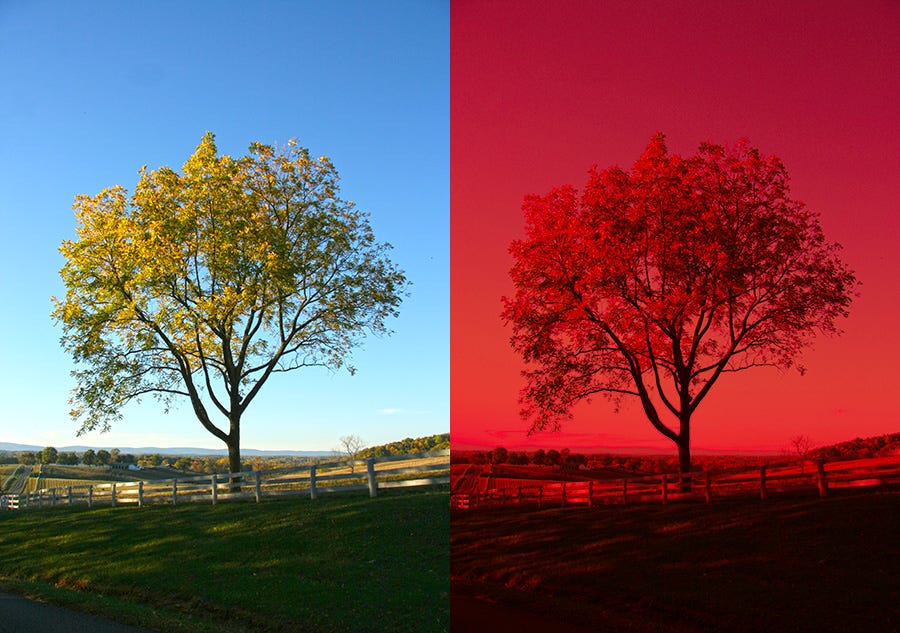
I introduce this update on the state of affairs of Stratospheric Aerosol Injection (SAI) with a question because we all need to be aware that there is more involved in combating climate change than money; there are effects that cannot be monetized and are thus considered unimportant by some. As for myself, though I really enjoy expressionist art, I vastly prefer the image on the left to the simulated post-SAI version on the right.
This post updates the series of four posts on SAI [1] – [4] (plus one for paid subscribers only) that I published here in 2024. A quick search of the internet and of the arXiv preprint server revealed very few scientific papers since then; I review the ones I consider important here.
Ch. 1: SAI feasible using existing aircraft (?)
Almost all the studies of SAI have considered injection of aerosols at mid- to equatorial latitudes, where the boundary between the troposphere and stratosphere is at an altitude above that reachable by most aircraft. Recently, a team of researchers studied the possibility of injection at far northern and southern latitudes, where the stratosphere dips to an altitude that is reachable by many commercial aircraft that are capable of carrying 100+ (metric) ton payloads [5]-[6]. Their results indicate that with injection of 12 million (metric) tons of sulfates per year a reduction of global temperatures by 0.6 C could be achieved. This is in comparison to a 2 C reduction with the injection of ca 20 million tons at moderate latitudes. Furthermore, their results would entail performing the injection in the spring and fall only, as opposed to year-round.
What, exactly, does injecting 12 million tons of material into the stratosphere entail? If the idea is to temporarily repurpose existing aircraft, it means installing tanks along with pumps to move the material in the cargo bays, and fitting the aircraft with some sort of external dispersal nozzles, connected through the fuselages. After use, these items would be removed and stored, allowing the aircraft to return to their normal service. An engineering problem, and solvable, at least in the case of dedicated cargo aircraft. Aside from that, how many aircraft would it take?
As it turns out the total volume of air cargo handled throughout the world in a recent year was 57.7 million tons [7]. So the average monthly tempo is 4.81 million tons. Injecting 6 million tons into the stratosphere in each of two months (one each spring and fall) would require operating the world’s entire air cargo fleet at 125% of the average tempo. Adding a half month in each season would reduce the tempo to a more reasonable 83%. In either case, the number of aircraft required to do the job amounts to essentially all the world’s air cargo capacity. This tells us two things: First, that using the existing air cargo fleet for even limited SAI would be tremendously disruptive; and Second, that it would require near universal international cooperation and coordination. Apparently feasibility is in the eye of the beholder.
Ch. 2: SAI has minimal impact on solar energy production
In November Sebastian Kebrich and his fellow workers reported on the results of an analysis of the effects of injecting 20 million tons of SO2 per year into the stratosphere on photovoltaic (PV) energy production [8]. They assumed that all the SO2 would be injected over the equator, with subsequent uniform dispersal throughout the stratosphere. Their results indicated a significant range in effects, ranging from less than 1% up to 12% reduction in PV output, depending on location and season. The conclusion is that SAI does not substantially impact solar energy production.
Ch.3: SAI models uncertain about predicted effects on rainfall
The work of McGraw and Polvani [9] is notable not only for its consonance with other studies in predicting reduced precipitation at tropical latitudes resulting from SAI in quantities necessary to produce an optical depth of 0.35 (tonnages varying due to iterating on differing mean particle sizes), but mostly for its highlighting the difficulty of reliably predicting SAI effects on account of uncertainties in modeling of cloud radiative processes. (Modeling of cloud interactions has been one of the great challenges of climate science.) The authors raise “the concern that any SAI deployment might proceed without sufficient knowledge of its hydroclimate consequences.”
Ch. 4: Scientists voice their opinions on SAI
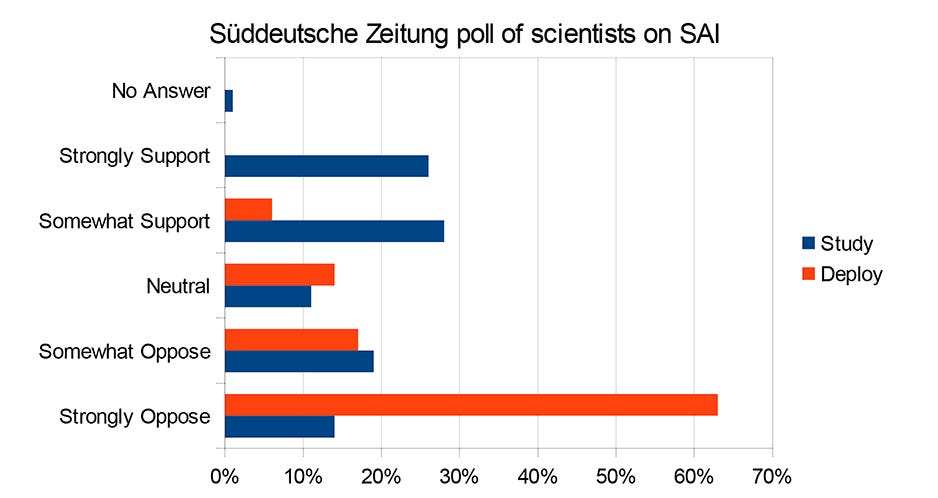
A recent poll of scientists conducted by the Süddeutsche Zeitung in November 2025 [10] was concerned with two forms of solar geoengineering, one of which was SAI. The respondents were asked about their support or opposition to two questions: First, whether research consisting of laboratory experiments, computer modeling, and limited field experiments should be allowed (“Study”); and Second, whether the technique should be allowed to be implemented under certain conditions (“Deploy”).
The results are presented in the bar chart below. While a slim majority (54%) favor continued research on SAI, an overwhelming majority (80%) oppose its practical implementation. I find it encouraging that a strong scientific consensus has emerged in opposition to SAI implementation, although I am aware of the tendencies among business people and politicians to disregard scientific advice.
Ch.5: SAI research needs governance
The article by Shuchi Talati provides a good tutorial explanation of the need for field experiments as a prelude to SAI deployment, along with some examples of experiments not taking place at least in part due to the ethical behavior of the researchers (who asked the local people for permission and were rebuffed) [11]. She also bolsters her case for governance by citing examples of bad behavior by for profit companies. A failing is her claim that SAI “has the potential to be implemented relatively quickly and cheaply”, which invites the question: Relative to what? Perhaps if the investors looking to make a quick buck were made aware of the true scale of SAI there might be fewer problems with rogue experiments. Nonetheless, the piece is worth reading for developing an understanding of the need for experiments to validate the computer models and to fill in gaps in our knowledge.
I promised to constantly remind my readership of the need for everyone who believes in freedom and democracy to behave in accordance with those beliefs, every day. To remind ourselves of what that means, see

Notes
[1] https://stephenschiff.substack.com/p/stratospheric-aerosol-injection-sai
[2] https://stephenschiff.substack.com/p/stratospheric-aerosol-injection-sai-ef4
[3] https://stephenschiff.substack.com/p/stratospheric-aerosol-injection-sai-9bc
[4] https://stephenschiff.substack.com/p/health-effects-of-stratospheric-aerosol
[5] Duffey, A., et al. (2025). Low‐altitude high‐latitude stratospheric aerosol injection is feasible with existing aircraft. Earth’s Future, 13, e2024EF005567. https://doi.org/10.1029/ 2024EF005567
[6] Harvey, C. (2025). Solar Geoengineering Is Possible with Existing Aircraft, Study Finds. Scientific American, 2 May 2025, https://www.scientificamerican.com/article/solar-geoengineering-is-possible-with-existing-aircraft-study-finds/
[7] https://www.statistica.com/topics/7347/air-cargo-industry-worldwide/
[8] Kebrich, S., et al. (2025) Impacts of stratospheric aerosol injection on renewable energy systems. https://arxiv.org/abs/2511.13376
[9] McGraw, Z. and L.M. Polvani (2025). Direct radiative impacts of stratospheric aerosols on the tropical troposphere: Clouds, precipitation and circulation in convection-resolving and global simulations. https://arxiv.org/abs/2512.06163
[10] Palm, T. and C. von Eichhorn (2025). Klima kühlen, Wolken machen. Süddeutsche Zeitung, Nr. 272, 26 Nov. 2025, s.12
[11] Talati, S. (2025). The urgent need for research governance of solar geoengineering. Physics Today, December, https://doi.org/10.1063/pt.5b8fb6172f