
proton-Boron Fusion
Trump's unnoticed grift?
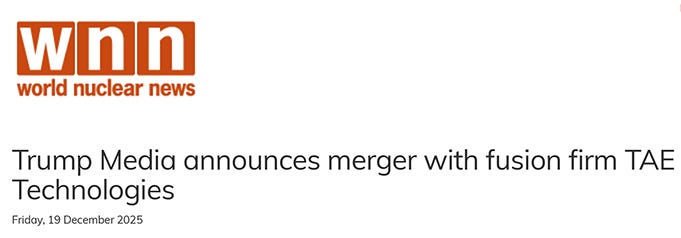
If the title of this post didn’t get your attention, surely the graphic did. At least that is what happened to me. Why on earth would “Drill, baby drill!”, “Bring back coal!”, clean energy credit canceling, wind farm permit revoking, climate change denying, fossil fuel industry promoting Donald Trump be investing hundreds of millions of dollars in fusion energy? I’ll posit a reason, but first, some science.
In an earlier post, the production of energy by harnessing fusion reactions focused on reactions involving isotopes of Hydrogen. [2] That was due in part to the notoriety of laser fusion at the time as well as the existence of a large international effort to accomplish it via plasma confinement (the ITER program) and the attractiveness of Deuterium-Tritium (DT) fusion from the standpoints of temperature and reactivity. There it was noted that fusion of Hydrogen is the principal source of energy in all but the oldest of stars.
There are other possibilities for producing fusion energy on earth, and the drawbacks of the DT approach, for example the rarity of Tritium [3] have encouraged research into others, including the proton + 11Boron → 3α reaction. 11Boron, pronounced Boron eleven, is the most common stable isotope of Boron, and has 5 protons and 6 neutrons in its nucleus. α designates an alpha particle, which is a 4He nucleus. From an economic and sustainability point of view, the use of Hydrogen and Boron is highly attractive as both elements are very abundant. Moreover the reaction does not produce any neutrons (absent impurities; an important caveat) and electricity is produced directly in principle. Now the down side.
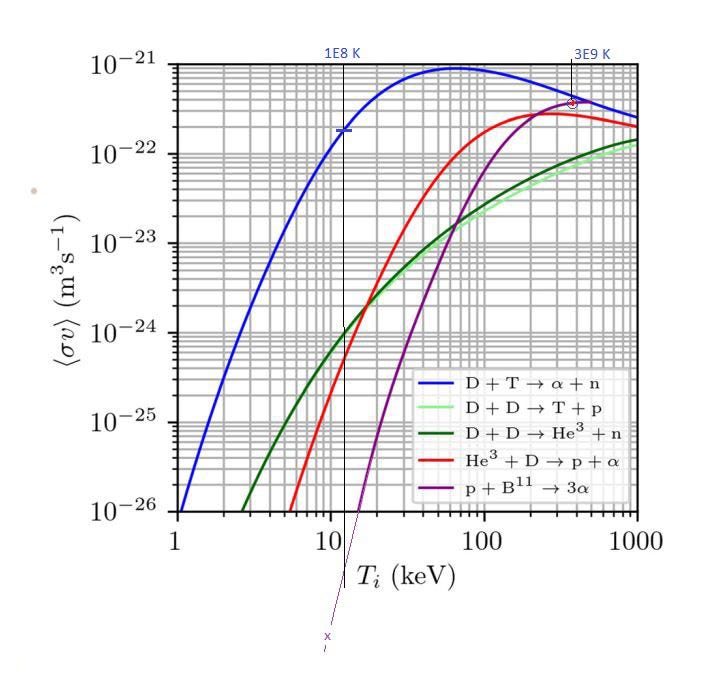
The curves above, modified from a figure in [4], shows the reactivity versus temperature as measured in thousands of electron volts for several processes. (The ordinary temperature T in Kelvins is related to the energy, designated above as Ti, by Ti = 3kT/2 where k is Boltzmann’s constant.) Of interest here are the blue and purple curves. I’ve added thin vertical lines corresponding to temperatures of 100 MK (Million K) and 3 GK (Billion K). The former is the design temperature for ITER, with a reactivity of about 2E-22 in units of square meters times meters per second. The 3 GK marker and other annotations are explained below.
Any attempt to accomplish fusion entails the production of a very high temperature and density environment; one of the two ways of doing that on earth involves the production, confinement and heating of a plasma. A number of approaches have been or are being explored. One such approach, exemplified by ITER, involves a toroidal chamber with plasma confinement accomplished via magnetic coils wrapped around it. Toroidal confinement of high temperature plasmas requires prodigious magnetic fields; indeed so large that this form of confinement at the requisite temperature was impossible prior to the invention of superconducting magnets. Since the ITER project began progress in high temperature superconductors and hence superconducting magnets has been rapid, so that there is essentially no issue concerning the magnets today.
But things were far different in the 1990s, when the firm Tri-Alpha Energy was founded. That company, currently named TAE Technologies, had a different vision, both regarding the elements to be fused and the mechanism of plasma confinement. They sought to use a cylindrical containment vessel rather than a toroid, and a technique called Field Reversed Configuration (FRC) to achieve confinement and fusion. At the time, FRC implementations suffered from instability problems leading to insufficient confinement times. [5] One of TAE’s claims to fame is that they appear to have solved that problem. [6] Not having a background in plasma physics, I am unsure as to whether this advancement was due to their use of neutral beam injection in place of theta pinch. You can find a neat visualization of the self-organization and merging of two oppositely moving plasma toroids at [7].
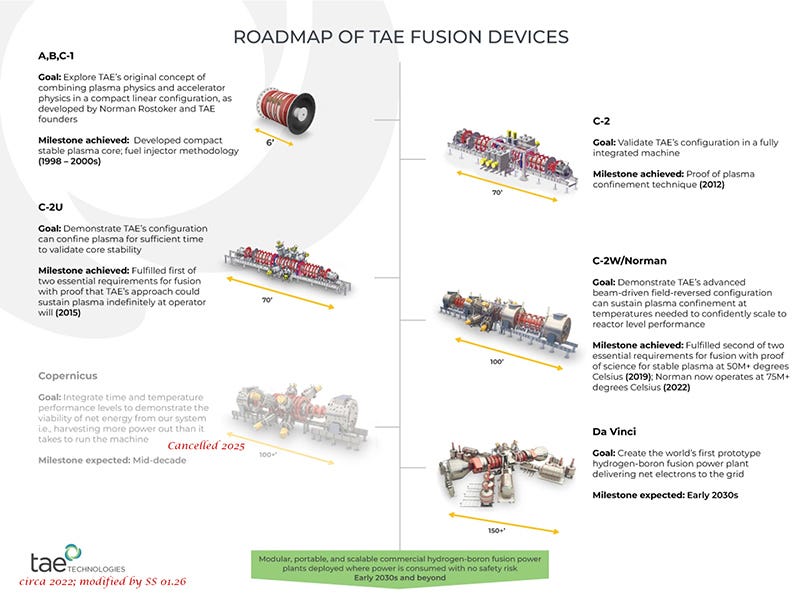
As indicated in the roadmap figure above, TAE made steady progress over more than a quarter century, reaching a point in 2022 where they had exceeded their design goal (of achieving a plasma temperature of 50 MK ) by 50%. To put that in proper perspective in relation with what is required, though, refer to the reactivity plot at the top of the post. There, I have extrapolated the reactivity curve downward according to the Rayleigh model; the value of Ti corresponding to the achieved T = 75 MK is marked by an “x”. Comparing that point with a reasonable reactivity for net energy production (the short blue horizontal line intersecting the blue curve, representing the ITER operating point) one sees that the achievement is more than 5 orders of magnitude (factor of over 100,000) below what is needed. In terms of temperature, the achievement is a factor of 40 below TAE’s announced goal of 3 GK (The red dot on the purple curve). Note also that to achieve the same reactivity of ITER the temperature required for the p + 11B → 3α process needs to be approximately 1 GK. (In fact this latter number was TAE’s goal at one time; pushing for 3 GK makes sense from an engineering viewpoint because it can achieve success while falling somewhat short of the temperature goal.)
Until very recently, it was TAE’s plan to build another research machine, designated Copernicus, before committing to a final design. Copernicus was targeted in the 2022 roadmap to achieve a temperature of 100 MK but in light of the achievements of the predecessor apparatus would have likely achieved a higher temperature. Regardless, it showed a disciplined, science-driven approach on the part of TAE’s leadership toward the end goal, finding and solving problems one by one with each step.
Incidentally, TAE had received ca $1.3 B in private capital, from investors including Google, in its first 25 years. How much of that was unspent as of 2025 is unknown.
In 2025 two things happened: Trump Media invested $200M (with a promise of $100M more) and Copernicus was canceled. It is unclear which happened first, but the order of events is important. The possibilities include: (a) TAE decided that the technical challenges to be met were not so serious as to warrant another experiment; (b) TAE decided that it could not attract the capital necessary to fund Copernicus; and (c) The new management decided they did not want to spend money on Copernicus because doing so would signal risk to potential suckers investors.
New management, you say? Yes. As opposed to the usual situation, whereby investors allow the scientist founders to continue making the decisions, confining their mechanism for informing said decisions to board membership, the Trump Media deal has resulted in a merger to form a publicly traded corporation with dual CEOs: Michl Binderbauer (of TAE) and Devin Nunes (of Trump Media). Yes, that Devin Nunes. Chairman of the new board will be the venture capitalist Michael Schwab, who claims involvement with TAE for more than twenty years. Per [1] the valuation of the new company is $6 B; as Trump Media own 50%, for which they promise to pay $0.3B, . . ., well, you can do the math.
TAE and especially their new partners will imply that this is a sure thing, that they will successfully scale up from a 75 MK experimental apparatus to a 3 GK, grid connected, 50 MW fusion power plant by the early 2030s, but it is not. There are many unknowns and one looming known problem, Bremstrahlung, facing them. (Bremstrahlung, “braking radiation” auf Englisch, is a widely observed phenomenon whereby charged particles radiate energy when subjected to acceleration. The rate of energy loss is proportional to the particle’s charge and the magnitude of the acceleration. Ionized Boron, the target in p-B fusion, has a charge of 5, and as you will notice from [7] it’s moving in a tight circular path in a FRC.) The there is a variety of positions on the severity of the problem, according to the sets of assumptions. [8] – [9] What is arguably more important to the new partners in the enterprise is the inflow of money that can be siphoned off, rather than the long term prospects for commercially viable fusion energy.
I promised to constantly remind my readership of the need for everyone who believes in freedom and democracy to behave in accordance with those beliefs, every day. To remind ourselves of what that means, see

Notes
[2] https://stephenschiff.substack.com/p/fusion-energy-on-earth
[3] https://stephenschiff.substack.com/p/fusion-powers-achilles-heel
[4] Wurzel, S. and S. Hsu (2022). Progress toward fusion energy breakeven and gain as measured against the Lawson criterion. Phys. Plasmas 29, 062103 https://doi.org/10.1063/5.0083990
[5] Omelchenko, Y.A. (2015). Formation, Spin-up and Stability of Field-Reversed Configurations. Phys. Rev. E 92, 023105 https://doi.org/10.1103/PhysRevE.92.023105
[6] Gota, H., et al. (2019) Formation of hot, stable, long-lived field-reversed configuration plasmas on the C-2W device. https://sun.ps.uci.edu/people/zlin/bib/gota18p.pdf
[7]
Note however that the FRC in this video is produced by a theta pinch. However it depicts the formation of the two plasma toroids in planes normal to the axis of the containment vessel and thus of the solenoidal magnetic field lines, along with the subsequent motion. The applied field does not perform the same containment function as that for the case of a Tokomak like ITER.
[8] Liu, S.J., et al. (2024) Proton-boron fusion scheme taking into account the effects of target degeneracy. Phys. Rev. Res. 6, 013323 https://doi.org/10.1103/PhysRevResearch6.013323
[9] Wang, H-Y., et al. [2026]. Revisiting p - 11B Fusion: Updated Cross-sections, Reactivity, and Energy Balance. https://arxiv.org/pdf/2601.00241v1
Although I am not a physicist I was able to digest the information/charts provided and got the drift (grift) of the article. Having worked in marketing for a large corporation I will say that this is plainly all that this new “merger” is. A social media outfit selling snake oil to uneducated folk who hope they will be early first investors to get rich quick. As they say “Hope is on the same page in the dictionary as horsesh*t.”